












Key takeaways
- Borneol is a bicyclic monoterpenoid alcohol, C10H18O, with a molecular weight of 154.25 g/mol and CAS number 507-70-0.
- Unlike most terpenes it is a solid at room temperature: white, waxy crystals that melt at about 202 to 208 C and boil at about 212 C.
- PubChem records its odour as piney and camphor-like and its taste as reminiscent of mint.
- It is classed as a flammable solid, with a closed-cup flash point of about 60 C.
- Elite Terpenez sells profiles with pine, mint and herbal aromas in several lines. Their listed aroma notes describe the smell, not the contents.
- Never use a concentrated terpene undiluted. Test a small batch first and work from the calculator’s starting cuts.
What is borneol?
Borneol is a bicyclic monoterpenoid: a ten-carbon molecule built from two isoprene units, folded into two joined rings, with an alcohol group attached. Its formula is C10H18O and its molecular weight is 154.25 g/mol, according to PubChem’s borneol record. Its systematic name is 1,7,7-trimethylbicyclo[2.2.1]heptan-2-ol.
The name points to Borneo, the island whose camphor trees were an early source of the crystals. Borneol is closely related to camphor, which is the same skeleton with a ketone in place of the alcohol. Chemists can turn one into the other, and that family link explains the smell.
If you are new to the topic, our guide to what terpenes are covers the basics before the detail below.
What does borneol smell like?
Borneol smells of pine and camphor. PubChem’s entries record the odour as “piney, camphor-like” and the taste as burning and somewhat reminiscent of mint. People who work with it often describe a clean, woody, resinous smell with a cool, minty lift, a little like pine needles crossed with menthol.
Because it is a solid, borneol is not usually met as a pourable liquid on its own. In practice it is dissolved or blended into other ingredients, and the aroma it carries is a supporting note that adds a crisp, balsamic edge more than a leading flavour.
Here is how those impressions break down in a finished aroma:
- Top: a sharp, camphor-like freshness.
- Middle: pine, resin and a faint mint.
- Base: a dry, woody finish that lingers.
What are the key facts about borneol?
The table below puts borneol next to three related compounds so you can compare the numbers. Data comes from PubChem records for each molecule, and a peer-reviewed review for the borneol melting range.
| Compound | Class | Formula | CAS number | Melting point | Aroma |
|---|---|---|---|---|---|
| Borneol | Bicyclic monoterpenoid alcohol | C10H18O | 507-70-0 | About 202 to 208 C | Piney, camphor-like |
| Camphor | Bicyclic monoterpenoid ketone | C10H16O | 76-22-2 | About 174 to 179 C | Penetrating, camphor |
| Isoborneol | Bicyclic monoterpenoid alcohol | C10H18O | 124-76-5 | About 212 to 216 C | Camphor |
| Menthol | Monocyclic terpene alcohol | C10H20O | 89-78-1 | About 38 to 43 C | Peppermint |
A few more figures help with handling. Borneol boils at about 212 C and has a density of around 1.01 g/cm3, so unlike most terpenes it sinks in water. It is only slightly soluble in water, at about 738 mg/L, but dissolves well in ethanol and ether. PubChem classes it as a flammable solid with a closed-cup flash point of about 60 C.

Where is borneol found in nature?
Borneol occurs in the wood and leaves of several aromatic plants. A peer-reviewed review notes that natural D-borneol is obtained from the branches and leaves of camphor laurel (Cinnamomum camphora), while L-borneol is obtained from the leaves and shoots of Blumea balsamifera, a plant in the daisy family. It also explains that synthetic borneol is mainly made by reducing camphor or from alpha-pinene found in turpentine. You can read the details in the review on PubMed Central.
The same review lists the physical form of all three types as a crystalline powder or flake crystal with a cool camphor scent and a melting point of roughly 201 to 210 C. Borneol also turns up as a minor component in the essential oils of rosemary, lavender, sage and other herbs, where it adds a camphor-like edge to a larger mixture.
Amounts vary with species, region and extraction method, so figures from one study should never be treated as a universal number. In a finished flavour or aroma product, borneol is almost always one note among many.
How is borneol different from camphor and pinene?
Borneol, camphor and isoborneol all share the same bornane skeleton. Camphor has a ketone group, borneol and isoborneol have an alcohol group, and the difference between borneol and isoborneol is the direction the alcohol points. The smells are close cousins: borneol is usually described as slightly softer and more woody than camphor.
Pinene is a different branch of the same family. Alpha-pinene, covered in our pinene guide, is a bicyclic hydrocarbon with a sharp, resinous pine smell and no alcohol group. Borneol can be made from pinene in industry, which is part of why pine-led and camphor-led aromas overlap so much.
For a lighter, sweeter take on pine, see our terpinolene guide. Where terpinolene reads as fresh and floral, borneol reads as dry, woody and camphor-like.
How is borneol sourced?
Borneol reaches a finished flavour or aroma profile by one of three routes:
- Isolated from plant material: natural borneol is recovered from camphor laurel or Blumea balsamifera and refined into crystals.
- Present in a whole plant extract: borneol alongside the other terpenes the plant made, as in cannabis-derived terpenes (CDTs).
- Present in a botanical blend: borneol-style notes combined with other botanical-derived terpenes (BDTs) to recreate a target aroma.
Which route suits you depends on whether you want a single clean camphor note or a layered, strain-like profile. A layered profile usually smells more natural, while an isolated crystal is more predictable but harder to handle.
Which Elite Terpenez profiles have a pine, mint and herbal aroma?
Elite Terpenez sells many profiles with a pine, mint or herbal direction across the Diamond, Premium, Natural, DNA and Flavour Infused lines. We do not state the contents of any profile, so the table shows each profile’s listed aroma notes only. Profiles in the same family of smells as borneol, such as these, are a good place to start:
| Profile | Line | Listed aroma notes |
|---|---|---|
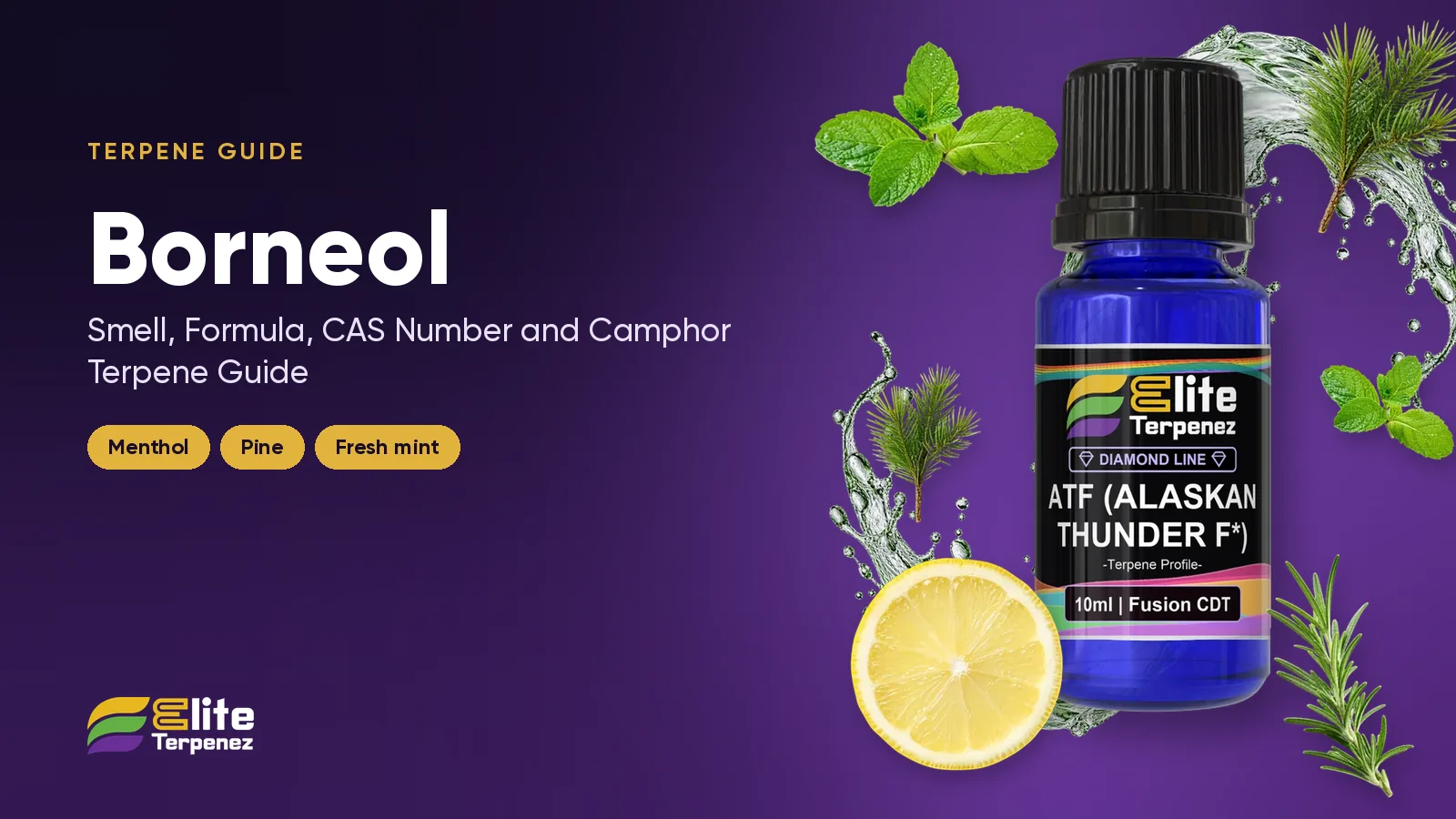
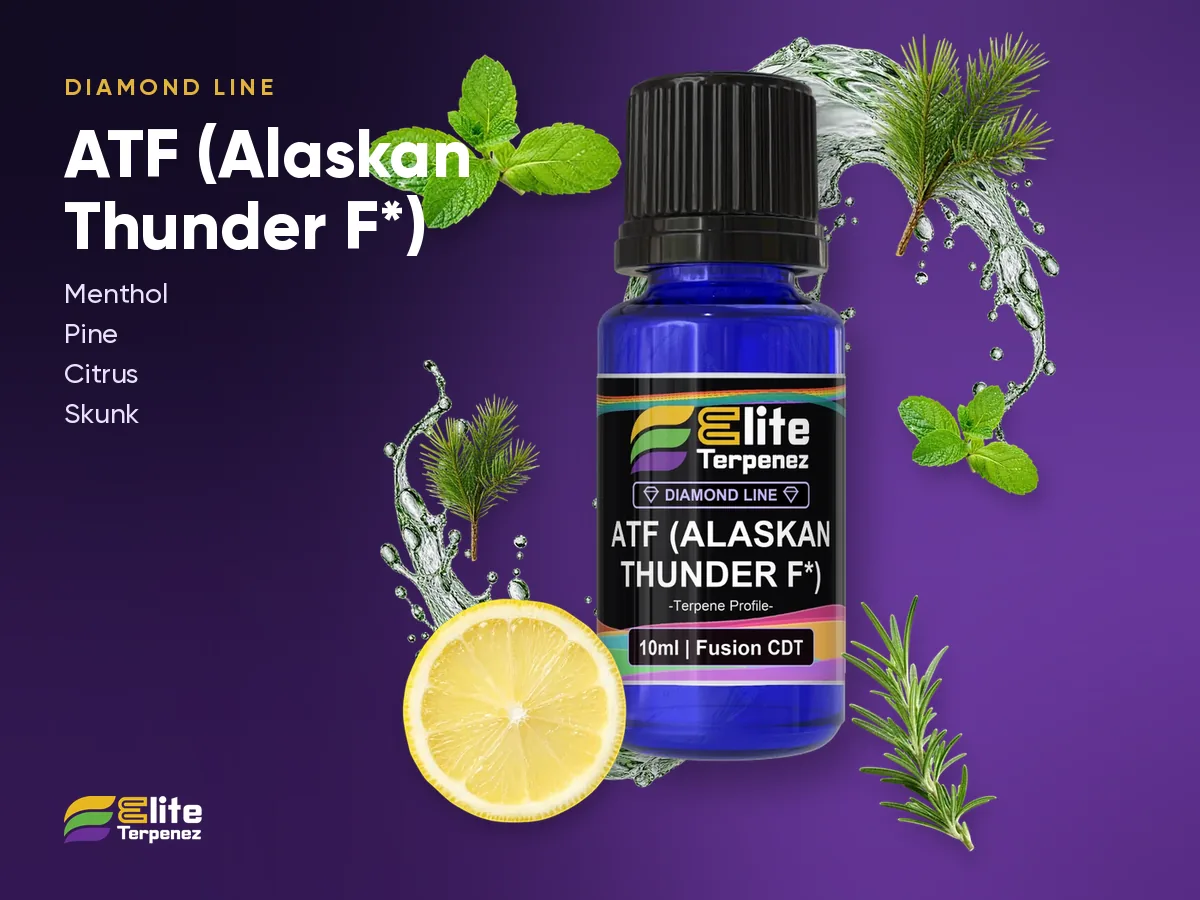
| ATF (Alaskan Thunder F*) | Diamond Line (CDT) | Menthol, pine, citrus, skunk, sage |
| ATF (Alaskan Thunder F*) | Premium Line (CDT) | Fresh pine citrus, earthy undertones, sometimes skunky with hints of mint |
| ATF (Alaskan Thunder F*) | Natural Terpenes (BDT) | Menthol and pine, bright citrus, skunk and sage |
| ChemDawg | Premium Line (CDT) | Pine, herbal, diesel |
| Kush Mintz DNA | DNA Series | Cool mint, earthy kush, creamy sweetness |
| Spearmint Supreme | Flavour Infused (BDT) | Fresh spearmint, sweet and clean, herbal finish |
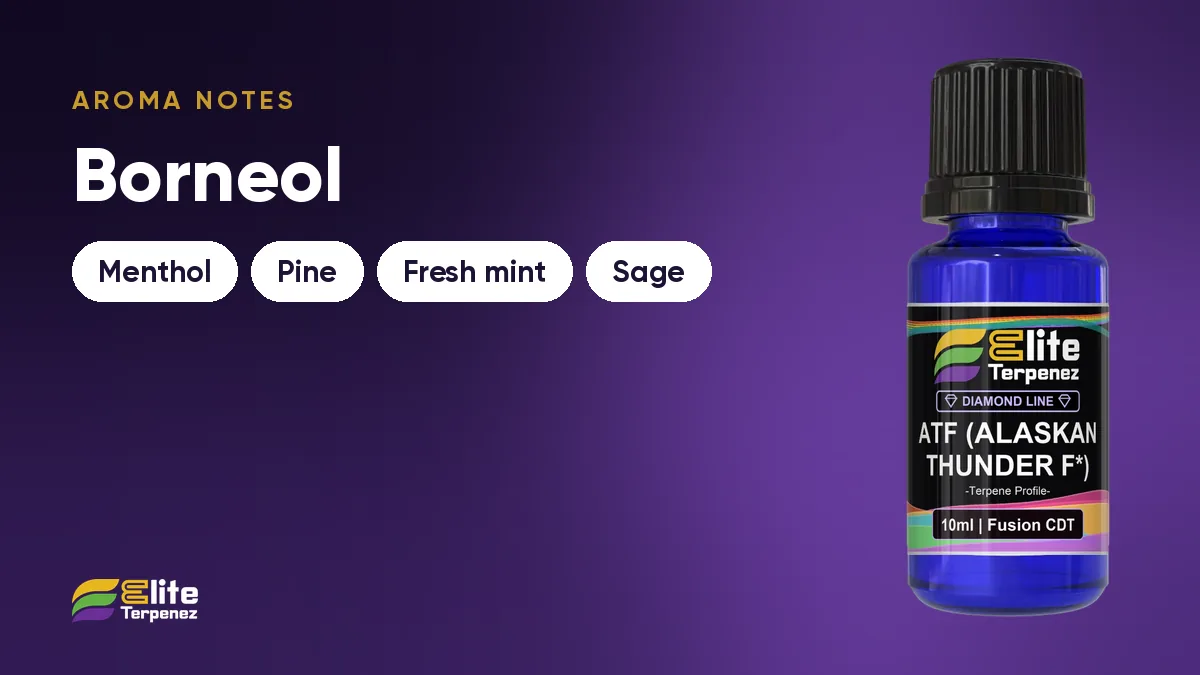
For menthol and pine together, the three ATF profiles show the same flavour direction across three lines, which makes them a handy way to compare how a line changes the character. For pine with herbal and fuel notes, try ChemDawg. For a mint-led direction, look at Kush Mintz DNA or Spearmint Supreme. To browse more, see the Diamond Line, Premium Line and Natural Terpenes collections, or the full Flavour Catalogue.
Diamond Line terpenes contain no THC or other cannabinoids. For cannabinoid content of any other line, contact us and we will confirm before you order.

What does borneol pair with?
Borneol is a supporting note: crisp, dry and woody. It sharpens other flavours more than it carries a blend alone. Use these pairings as a guide when you plan a blend or choose between profiles:
| Pair a camphor-pine note with | Resulting impression | Example listed aroma notes |
|---|---|---|
| Pine | Forest, resin, clean wood | ChemDawg: pine, herbal, diesel |
| Mint | Crisp, fresh, sweet mint | Spearmint Supreme: fresh spearmint, sweet and clean, herbal finish |
| Citrus | Bright pine-citrus lift | ATF Premium: fresh pine citrus, earthy undertones |
| Sage and skunk | Herbal, savoury depth | ATF Natural: menthol and pine, bright citrus, skunk and sage |
These are separate profiles from the Elite range, each with its own listed notes. They show the direction of the pairing and say nothing about what any bottle contains.
How do makers use borneol-style notes for flavour and aroma?
Makers use pine-camphor-mint directions to give a product a crisp, clean, slightly resinous character. They appear in fragrance work, candles and home scent as well as flavour development, because the smell reads as fresh and woody. Done well, they add structure underneath sweeter notes.
A few practical points:
- Start low: camphor-like notes are penetrating, and too much turns harsh and overpowering in the nose.
- Build, do not stack: pair a pine or mint profile with a sweet or fruity one for balance.
- Test small: run a small batch, wait a day, and re-smell it before scaling.
- Mind the solid: if you work with pure crystalline borneol, it needs dissolving into a suitable carrier, and it may not dissolve in every base. Test solubility before you commit to a full batch.
What are the starting cuts and handling rules?
Terpene profiles are concentrated and must never be used undiluted. Elite Terpenez’s starting cuts are 6% for vape cartridges, 4% for concentrates, 2% for tinctures, 1% for edibles, 0.5% for beverages and 3% for topicals. Use the terpene mixing calculator to turn a percentage into a weight, and always test a small batch first.
Borneol has a notable hazard profile. PubChem’s classification lists it as a flammable solid. Wear gloves and eye protection, keep it away from children, pets, heat and flames, and work in a ventilated space. For general workplace guidance, see the HSE’s COSHH basics. Products are for adults (18+) only.
Storage
Store terpene bottles tightly closed in a cool, dark place; refrigerated is ideal. Air, light and warmth speed up ageing, so a half-empty bottle left open will lose its freshness faster than a full, closed one. Decant what you need and reseal promptly.
Keep containers sealed, because scent escapes from open bottles. If a pine or mint profile starts to smell flat or stale rather than crisp, it has probably aged, and it is better to test a fresh bottle than to adjust your recipe to compensate. Label the date you opened each bottle so you can track how long it has been in use.
Sizes and bulk
Profiles come in 2 ml, 5 ml and 10 ml bottles. For larger runs, ask about bulk on the wholesale and bulk page. Free UK delivery on orders over £80.

Frequently asked questions
What is borneol?
Borneol is a bicyclic monoterpenoid alcohol with the formula C10H18O, found in camphor laurel, rosemary, lavender and other aromatic plants. It forms white crystals with a CAS number of 507-70-0 and a piney, camphor-like smell. Makers use it as a flavour and aroma ingredient.
What does borneol smell like?
Borneol smells of pine and camphor with a faint mint-like edge. PubChem records its odour as piney and camphor-like. It is usually described as softer and more woody than camphor itself, and in a blend it works as a crisp supporting note rather than a leading flavour.
What is the difference between borneol and camphor?
Both share the same bicyclic skeleton and a similar smell. Borneol (C10H18O, CAS 507-70-0) has an alcohol group, while camphor (C10H16O, CAS 76-22-2) has a ketone group. Borneol melts at about 202 to 208 C, camphor at about 174 to 179 C. Industry can convert one into the other.
Is borneol a solid or a liquid?
Borneol is a solid at room temperature. It forms white, waxy crystals or flakes that melt at about 202 to 208 C and boil at about 212 C. That is unusual for a terpene, because most terpenes used in flavour work are liquids, so borneol is normally dissolved or blended into other ingredients.
Is borneol flammable?
Yes. PubChem classes borneol as a flammable solid, with a closed-cup flash point of about 60 C. Keep it away from heat, sparks and flames, store it tightly closed and work in a ventilated space. Wear gloves and eye protection and follow the safety information supplied with your product.
Which Elite Terpenez profiles have a pine and mint aroma?
Profiles with a pine, mint or herbal aroma include ATF in the Diamond, Premium and Natural lines, ChemDawg, Kush Mintz DNA and Spearmint Supreme. Each lists its own aroma notes on its product page. Elite Terpenez does not state the contents of its profiles, only their listed aroma notes and ingredients.
Which Elite Terpenez profiles are suggested for borneol, and what are their listed notes?
Start with Diamond Line ATF (Alaskan Thunder F*) (menthol, pine, citrus, skunk, sage); Premium Line ATF (Alaskan Thunder F*) (fresh pine citrus, earthy undertones, sometimes skunky with hints of mint); Natural Terpenes ATF (Alaskan Thunder F*) (menthol and pine, bright citrus, skunk and sage). Notes come from each product page, and every profile is sold in 2 ml, 5 ml and 10 ml bottles.
Ready to build a pine, mint or herbal flavour? Browse the Diamond, Premium and Natural ranges, order samples in 2 ml bottles, or contact us for bulk quantities and to confirm anything about a profile before you order.


