
















Key takeaways
- “Terps” is a casual short form of “terpenes”. The two words mean the same family of aroma molecules.
- Terpenes are built from five-carbon isoprene units. Monoterpenes have 10 carbons and sesquiterpenes have 15.
- In shops, “terps” often means a terpene profile, which is a blend, not one single molecule.
- CDT means cannabis-derived terpenes and BDT means botanical-derived terpenes. Elite Terpenez sells both, 471 profiles in all.
- Terps are concentrated. Never use them undiluted, test a small batch first and store them cool and dark.
- Elite Terpenez sells terpenes as flavour and aroma ingredients to adults (18+) only.
What does “terps” mean?
“Terps” is the everyday short form of “terpenes”. People use it in conversation, in forums and on product pages, and it means the same thing: the volatile, fragrant compounds that plants make. When someone says a product “has good terps”, they usually mean it smells and tastes good, because terpenes are what you notice first when you open a jar, peel an orange or crush a pine needle.
The slang is most common in cannabis culture, where the flavour of a strain is a big part of how it is talked about. But terps are not specific to cannabis. They are in lemon peel, lavender, black pepper, hops, mango, rosemary and thousands of other plants. This guide explains the word in plain terms, so you know what people mean wherever you meet it.
Are terps and terpenes the same thing?
Yes, in everyday use. “Terps” is simply the informal word and “terpenes” is the proper one. The only real difference is the setting, because a chemist writes terpene and a shopper types terps. There is one more related word worth knowing: terpenoid, which is a terpene that has been modified, usually by the addition of oxygen. Chemists separate them, but the two words are often used loosely for each other.
| Word | What it usually means | Where you see it |
|---|---|---|
| Terps | Slang for terpenes, or for a terpene profile | Chats, forums, product names |
| Terpenes | The family of aroma molecules made of isoprene units | Shops, guides, labels |
| Terpenoids | Terpenes with added chemical groups, usually oxygen | Chemistry and science articles |
| Terpene profile | A blend that recreates a specific aroma or flavour | Supplier catalogues, product pages |
Where does the word terpene come from?
The name goes back to turpentine, the resin product that comes from pine trees. The German chemist August Kekulé coined the term in 1866 for a group of hydrocarbons related to those found in turpentine, according to the Wikipedia article on terpenes. Pinene, one of the best-known terpenes, is a major component of turpentine, and it is still the molecule behind the smell of a pine forest.
So “terps” has a long history behind it. A word first used for pine resin chemistry now describes the aroma side of food, perfume and flavour work.
What are terps made of?
Every terpene is assembled from a small building block called isoprene, which has five carbon atoms. Plants join these blocks in different numbers and shapes, and the number of blocks sets the family the molecule belongs to. Wikipedia describes the same pattern: monoterpenes are made of two isoprene units (C10), and sesquiterpenes of three (C15).
| Family | Isoprene units | Carbons | Examples |
|---|---|---|---|
| Monoterpenes | 2 | 10 | Limonene, pinene, myrcene, linalool |
| Sesquiterpenes | 3 | 15 | Caryophyllene, humulene |
The small ones tend to be lighter and more volatile, so you smell them quickly. The bigger ones are heavier and tend to linger. That is why a fresh citrus note and a deep spicy note can sit side by side in the same profile and still read as different layers.
What do terps smell like?
Each terpene has its own aroma, and the names are worth learning because they show up in product descriptions all the time. The table pairs some common terps with the smell they are known for and a plant where they occur. Read the full guide for any you want to go deeper on.
| Terpene | Aroma | Found in | Guide |
|---|---|---|---|
| Limonene | Fresh citrus | Lemon and orange peel | Limonene guide |
| Pinene | Pine and resin | Pine needles, rosemary | Pinene guide |
| Linalool | Floral, lavender-like | Lavender | Linalool guide |
| Myrcene | Earthy and fruity | Hops, mango | Myrcene guide |
| Caryophyllene | Peppery and spicy | Black pepper, cloves | Caryophyllene guide |
You can check the chemistry of any of these on PubChem’s limonene record or its alpha-pinene record, which list formula, boiling point and natural sources.

What is a terp profile?
A terp profile is a blend of terpenes designed to recreate one aroma and flavour, such as a strain, a fruit or a dessert. Real aromas are never one molecule. A lemon smells like lemon because of limonene plus dozens of other compounds, and a profile aims to capture that layered whole rather than a single note.
That is why a profile name on a product page, such as Biscotti or Apple Fritter, describes a smell and not an ingredient. A good listing tells you the profile’s line, its aroma notes and its ingredients, so you can judge it on what is stated. Elite Terpenez does not state the composition or percentages of any profile, and a profile is a blend, not a single-molecule product.
Why do terps matter for flavour and aroma?
Most of what you call flavour is really smell. Your tongue detects only a few basic tastes, while your nose picks up the fine detail, and terpenes are among the most important aroma molecules in plants. That is why makers who want a recognisable flavour reach for terps rather than for sugar or colour alone.
It also explains why two products with the same base can feel quite different. A drink, a confection or a vapour that carries a layered terp profile smells fuller than one with a single flat note. Makers therefore treat terps as an ingredient to be chosen with care, tested in small batches and stored properly, because the volatile molecules that smell best are also the ones that fade first when a bottle is left open or warm.
Are terps the same as flavourings?
Not always. A terpene is a specific kind of molecule, while “flavouring” is a broad ingredient category that can include many other substances. Some ranges blend terpenes with added flavouring to reach a candy, fruit or dessert taste that plants alone would not give. On Elite Terpenez, the Infused Terpenes, Flavour Infused and Classic Flavour Infused ranges list botanical-derived terpenes together with flavouring in their ingredients, and the All Natural Infused range lists natural flavouring.
The Natural Terpenes and the Diamond, Premium and DNA lines list terpenes only. That is the practical way to tell them apart: read the ingredients on the product page, because the name of a profile does not tell you.
What is the difference between CDT and BDT terps?
You will see two abbreviations on a catalogue. CDT stands for cannabis-derived terpenes, and BDT for botanical-derived terpenes. They describe where the material comes from, not how the product smells.
- CDT: the Diamond Line and Premium Line, with 81 profiles between them.
- BDT: the Natural Terpenes, Infused Terpenes and most of the Flavour Catalogue, with 354 profiles.
- DNA Series: 36 profiles that list both cannabis-derived and botanical-derived terpenes.
Cannabis flower is a controlled drug in the UK and Elite Terpenez does not sell cannabis. Diamond Line terpenes contain no THC or other cannabinoids. For cannabinoid content of any profile other than the Diamond Line, contact us and we will confirm before you order. If you are comparing suppliers, our guide to choosing a UK terpene supplier explains how.
What do the common terp words mean?
Terp talk comes with its own vocabulary. The short glossary below covers the words you will meet on a product page or in a catalogue, in the way Elite Terpenez uses them.
| Term | Meaning |
|---|---|
| Terps | Slang for terpenes, or for a terpene profile |
| Terpene | An aromatic molecule built from five-carbon isoprene units |
| Terpenoid | A terpene with added chemical groups, usually oxygen |
| Terpene profile | A blend made to recreate a specific aroma or flavour |
| CDT | Cannabis-derived terpenes |
| BDT | Botanical-derived terpenes |
| Aroma notes | The smell and flavour words listed for a profile, such as citrus or spice |
| Starting cut | The percentage of terpene used as a first test in a finished product |
| Line | A range of profiles, such as the Diamond Line or Natural Terpenes |
| Lab report | A laboratory document about a specific material |

Which Elite Terpenez terps are good to start with?
If you are new to terps, pick a few profiles with clearly different aromas and compare them. The four below come from different lines. Their notes are the ones listed on each product page, and the lines are described honestly as CDT or BDT.
| Profile | Line | Listed aroma notes |
|---|---|---|
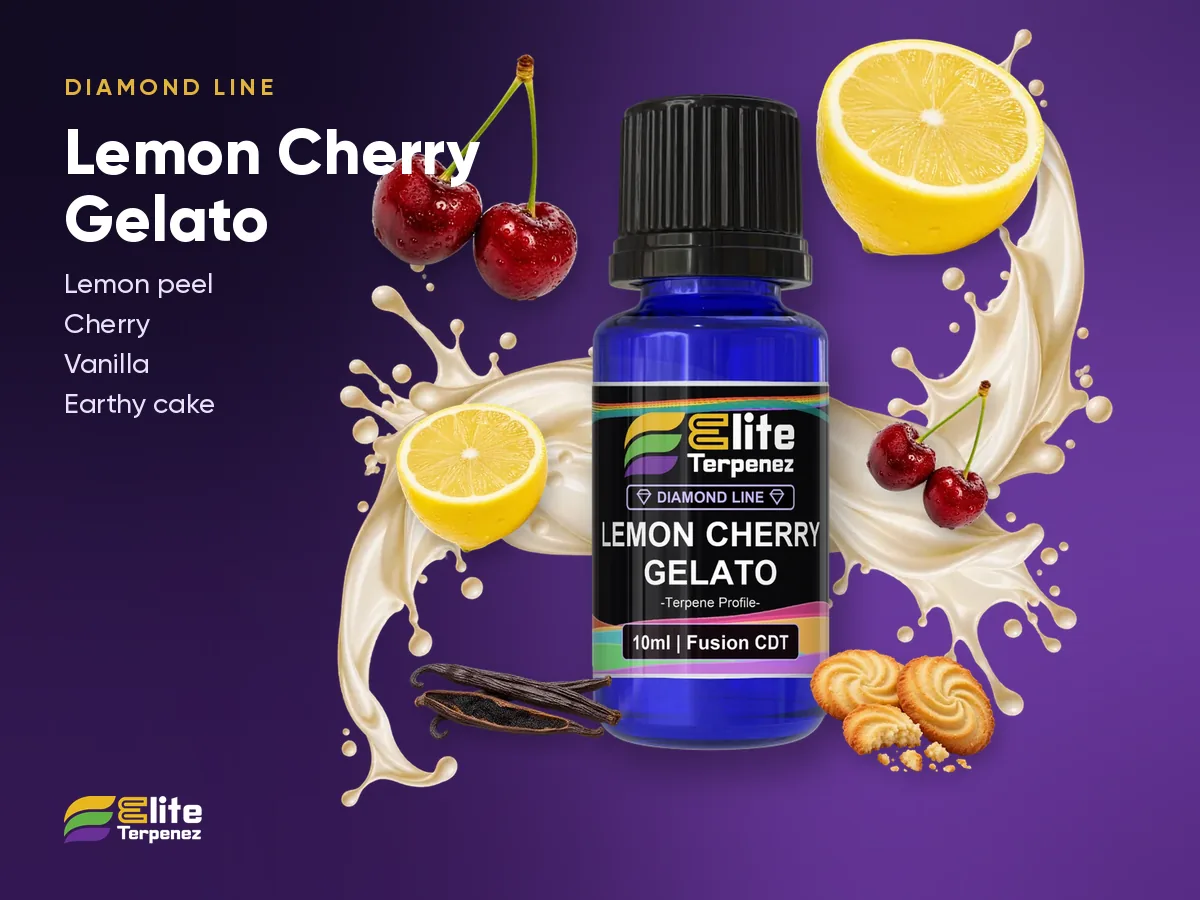
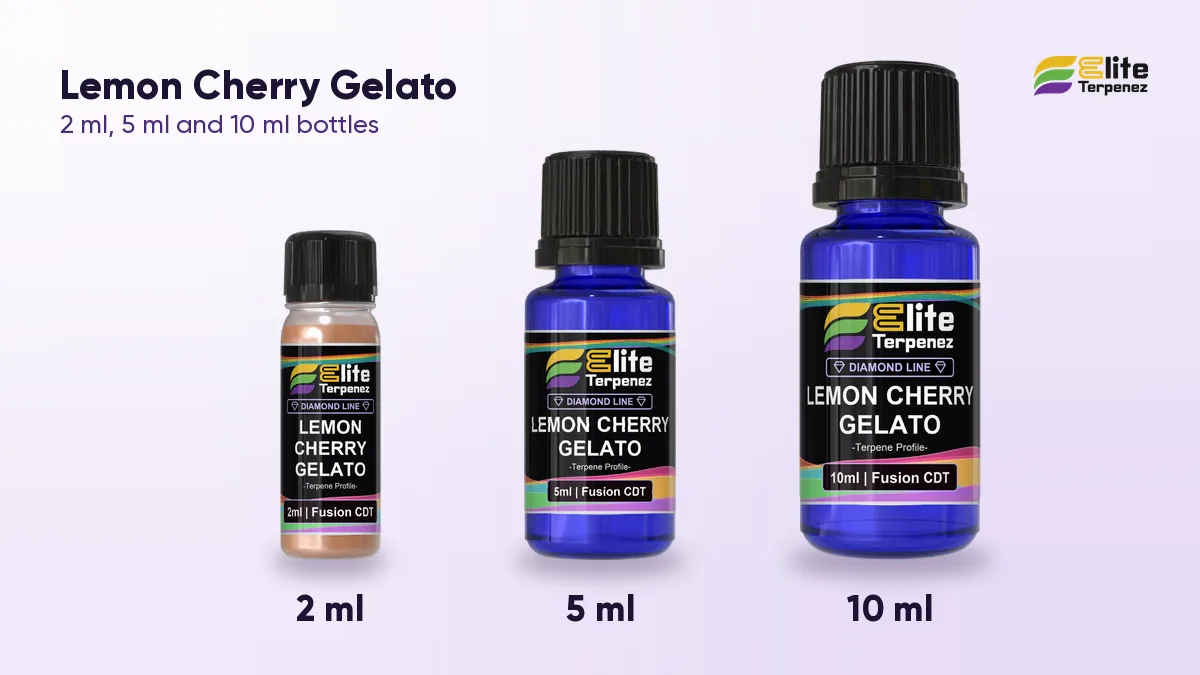
| Lemon Cherry Gelato | Diamond Line (CDT) | Lemon peel, cherry, vanilla, earthy cake |
| Apple Fritter | Natural Terpenes (BDT) | Baked apple, sweet glazed pastry, warm spice |
| Pink Goddess | Infused Terpenes (BDT) | Pink berry, sweet cream, delicate rose |
| Lovely Lychee | Flavour Infused (BDT) | Delicate lychee, floral sweetness, soft juicy finish |
To browse more, see the Diamond Line, the Natural Terpenes or the full Flavour Catalogue. Every profile comes in 2 ml, 5 ml and 10 ml bottles, so a 2 ml bottle is an easy way to try a terp before you buy more.
How do makers use terps?
Makers add a small amount of terpene to a finished base to give it a flavour and aroma. The amount is a percentage of the batch, and it is always low, because terps are concentrated. Elite Terpenez’s starting cuts are 6% for vape cartridges, 4% for concentrates, 3% for topicals, 2% for tinctures, 1% for edibles and 0.5% for beverages.
Treat those as starting points, not rules. Mix a small batch, label it, compare it with what you already make, and change one thing at a time. The terpene mixing calculator turns a batch size and a format into millilitres, and the guide to what terpenes are goes deeper on how they behave.
How should you handle and store terps?
Terps are concentrated, so the same rules apply to every product and every line:
- Never use a terpene undiluted.
- Wear gloves and eye protection.
- Keep bottles away from children, pets, heat and flames.
- Store them tightly closed, cool and dark. Refrigerated is ideal.
- Terpenes are for adults (18+) only.
Elite Terpenez sells terpenes as flavour and aroma ingredients and makes no claims about effects. For how the company describes its products, read the quality and safety page. This guide is general information and not legal or medical advice.

Where can you buy terps in the UK?
You can buy terps from specialist UK suppliers. Elite Terpenez is a UK store run by ELITETERPENES LTD, with 471 profiles across five lines and free UK delivery on orders over £80. Brands and manufacturers who need larger volumes can apply for a wholesale account on the wholesale and bulk page.
Frequently asked questions
What does terps mean?
Terps is slang for terpenes, the aromatic molecules that give plants their smell and taste. It can also mean a terpene profile, which is a blend made to recreate one aroma or flavour. The word is casual, so on a product page the proper term is usually terpenes or terpene profile.
Are terps and terpenes the same thing?
Yes, in everyday use. Terps is the informal short form and terpenes is the correct word. Terpenoids are a related group: terpenes that have been modified, usually by adding oxygen. Chemists separate the two, but the words are often used loosely for each other.
What is a terpene profile?
A terpene profile is a blend of terpenes designed to recreate one aroma and flavour, such as a strain, fruit or dessert. A profile is not a single molecule. Elite Terpenez lists each profile’s line, aroma notes and ingredients, but does not state its composition or percentages.
Where do terps come from?
Terps are made by plants, including citrus, pine, lavender, hops and cannabis. Suppliers either refine them from plant material or build them from botanical sources. CDT means cannabis-derived terpenes and BDT means botanical-derived terpenes. Elite Terpenez sells both as flavour and aroma ingredients.
Can I use terps straight from the bottle?
No. Terps in a bottle are concentrated, so they are diluted into a base and never used neat. Use the mixing calculator to plan a small test batch, and read how to use terpenes for starting percentages and mixing order.
Where can I buy terps in the UK?
You can buy terps from specialist UK suppliers such as Elite Terpenez, which sells 471 profiles in 2 ml, 5 ml and 10 ml bottles. Delivery is free in the UK on orders over £80, and wholesale accounts are available for UK brands and manufacturers. Terpenes are for adults (18+) only.
Ready to try a terp? Browse the Flavour Catalogue, order a 2 ml sample, or contact us to confirm anything about a profile before you order.


