










Key takeaways
- Linalool is an acyclic monoterpenoid alcohol, C10H18O, with a molecular weight of 154.25 g/mol.
- It smells floral, sweet and fresh, often compared with lavender and bergamot oil.
- It is a major component of lavender oil. One peer-reviewed analysis of lavender oil found about 26.5% linalool.
- It occurs as two mirror-image forms, and the two smell slightly different.
- Elite Terpenez sells floral-led profiles across several lines. Their listed aroma notes describe the smell, not the contents.
- Never use a concentrated terpene undiluted. Test a small batch first and use the calculator’s starting cuts.
What is linalool?
Linalool is a naturally occurring terpene with ten carbon atoms and one hydroxyl group, which makes it a terpene alcohol rather than a plain hydrocarbon. Chemists call it an acyclic monoterpenoid, meaning it is built from two isoprene units in an open chain rather than a ring. PubChem’s linalool record gives the formula as C10H18O and the molecular weight as 154.25 g/mol.
It is one of the most widely used aroma molecules in the world. Perfumers, flavourists and product makers rely on it for a clean, soft floral note that works in everything from fragrance to flavour. If you are new to terpenes in general, start with our guide to what terpenes are.
What does linalool smell like?
Linalool smells of fresh lavender blossom with a sweet, slightly woody and citrus-like lift. PubChem describes it as a colourless liquid with an odour similar to bergamot oil and French lavender, and as having a typical floral odour free from harsh camphor or turpentine notes. It is soft rather than sharp.
Words that describe linalool in a blend:
- Floral: lavender, lily of the valley, soft blossom.
- Fresh and citrus-like: a bergamot or orange-blossom brightness.
- Woody and spicy: a faint dry edge underneath.
- Sweet: a rounded, gentle sweetness, which is why it softens sharper notes.
What is linalool in lavender?
Linalool is one of the two main aroma molecules in lavender oil, alongside its acetate ester, linalyl acetate. In one peer-reviewed analysis of Lavandula angustifolia, the oil of the whole flowering top contained about 34.3% linalyl acetate and 26.5% linalool by gas chromatography. You can read the original study in PubMed Central.
These numbers are one study’s results. Lavender oils vary widely with variety, region, plant part and extraction method, and other studies report different ratios. The point for a flavour maker is simple: when someone says a smell is lavender-like, linalool and linalyl acetate are doing most of the work.
Where else is linalool found?
Linalool occurs in hundreds of plants. Besides lavender, notable sources include coriander, basil, bergamot, rosewood, mint-family herbs, and the peel oils of citrus fruit. In a sweet orange oil analysed in a peer-reviewed paper, linalool was the second-largest component at about 2.5%, behind d-limonene at about 90.9%.
It also turns up, usually in modest amounts, in cannabis flower. Lab reports on dried flower sometimes list it among the minor terpenes, behind caryophyllene, limonene and myrcene. In our Wedding Cake strain guide, for example, some reports list linalool as a secondary terpene.
What are the key facts about linalool?
The table puts linalool next to three other terpenes so you can compare the numbers. Data comes from PubChem.
| Terpene | Class | Formula | CAS number | Boiling point | Aroma |
|---|---|---|---|---|---|
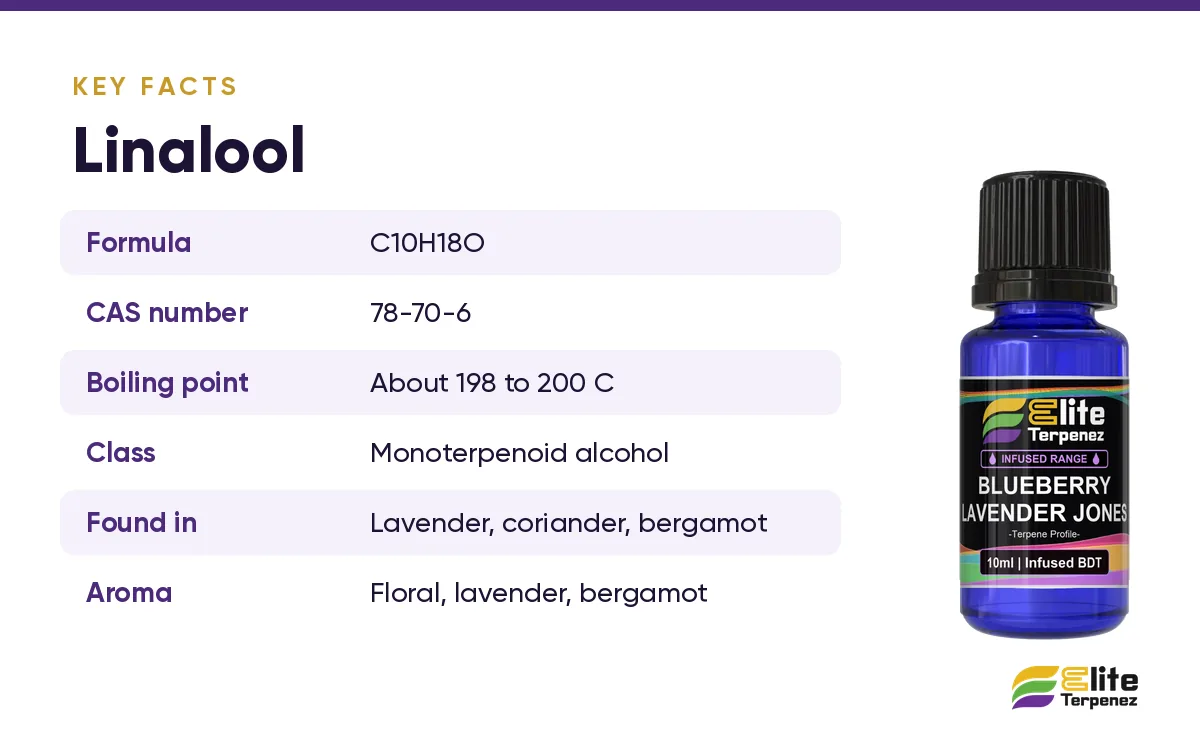
| Linalool | Monoterpenoid alcohol | C10H18O | 78-70-6 | About 198 to 200 C | Floral, lavender, bergamot |
| Limonene | Monoterpene | C10H16 | 138-86-3 | About 175 to 178 C | Citrus peel |
| Myrcene | Monoterpene | C10H16 | 123-35-3 | About 167 C | Earthy, musky, herbal |
| Alpha-pinene | Monoterpene | C10H16 | 80-56-8 | About 156 C | Pine, turpentine |
A few more figures help with handling. Linalool has a density of about 0.86 g/mL, a closed-cup flash point in the region of 75 to 78 C, and a water solubility of roughly 1.6 g/L at 25 C. It dissolves in alcohol, ether, fixed oils and propylene glycol but not in glycerin. For the citrus side of the picture, see our limonene guide.
Are there different forms of linalool?
Yes. Linalool has a chiral centre, so it exists as two mirror-image forms called (R)-linalool and (S)-linalool. They have the same formula and boiling point but smell slightly different. The (R)-form, CAS 126-91-0, is generally described as woody and lavender-like, while the (S)-form, CAS 126-90-9, is generally described as sweeter and more citrus-floral.
Natural sources usually favour one form, which is part of why a lavender oil, a coriander oil and a rosewood oil each smell a little different even though all contain linalool. Suppliers who list plain linalool under CAS 78-70-6 are generally describing a mix of both forms.
How does linalool differ from linalyl acetate?
Linalyl acetate is the acetate ester of linalool, and it smells sweeter, fruitier and more bergamot-like than the alcohol. Where linalool is clean, fresh and a little woody, linalyl acetate is rounder and more perfumed. Lavender oil contains both, and the ratio between them is a large part of what separates a rough lavender smell from a refined one.
For a maker, the practical lesson is that “floral” is not a single smell. A profile built around linalool alone will read cleaner and lighter, while one with softer, fruitier floral components will read warmer and sweeter.
How is linalool sourced?
Linalool reaches a finished product from three directions. It can be isolated from natural plant oils such as rosewood, coriander or lavender, it can be made by chemical synthesis, or it can arrive as part of a whole plant extract that already contains it alongside other terpenes. Synthetic and natural linalool share the same formula, but they can differ in which mirror-image form dominates, which is one reason their smell is not identical.
In flavour and aroma work this shows up in the lines Elite Terpenez sells:
- CDT, cannabis-derived terpenes: taken from the plant, so any linalool present comes with the rest of the plant’s aroma mix. The Premium Line uses live resin style, strain-specific CDTs.
- BDT, botanical-derived terpenes: taken from other botanical sources and blended to recreate a target aroma. The Infused ranges add flavouring for bolder results.
Which Elite Terpenez profiles have a floral aroma?
Elite Terpenez sells many profiles with a floral note, across the Premium, Classic Strains, DNA and Infused lines. We do not state the contents of any profile, so the table shows each profile’s listed aroma notes only. Profiles with a floral-led or floral-edged aroma such as these are a good place to start:
| Profile | Line | Listed aroma notes |
|---|---|---|
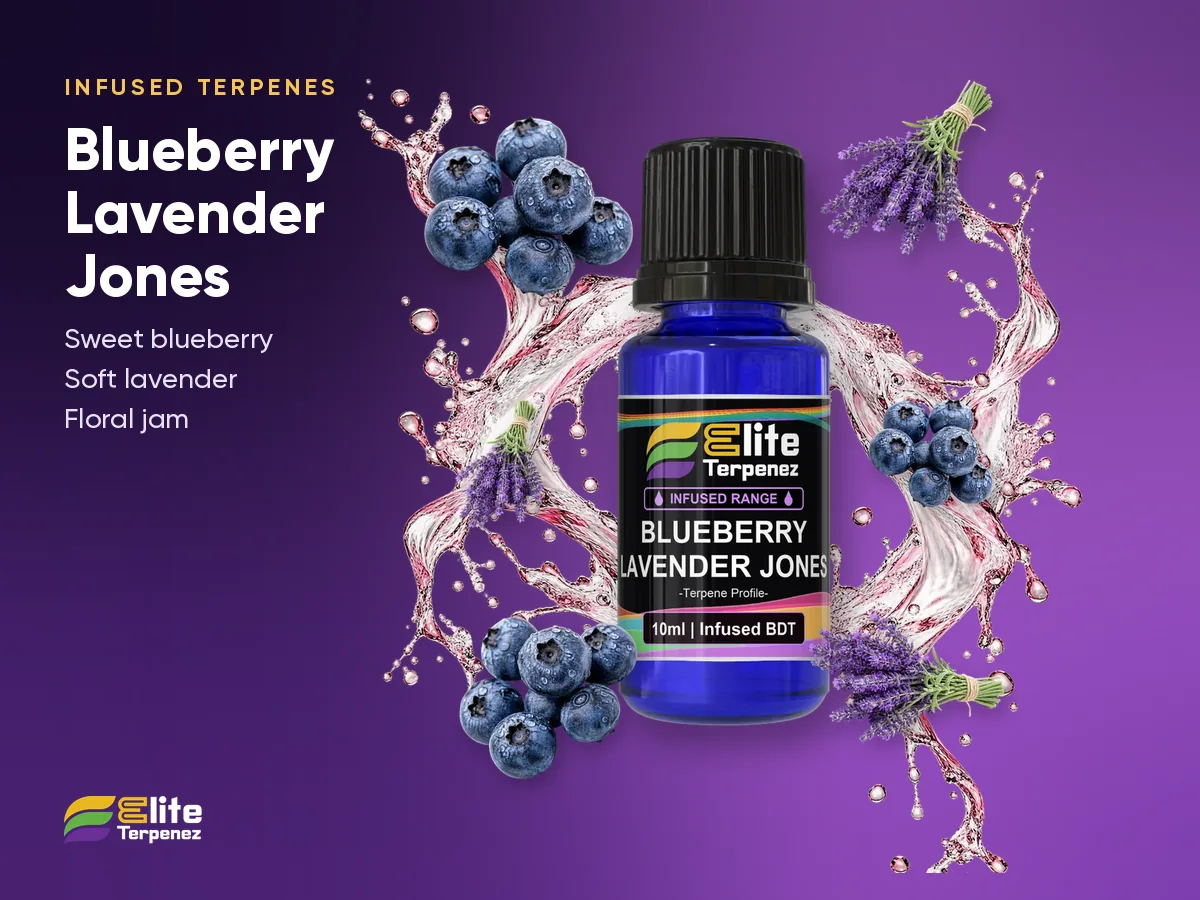
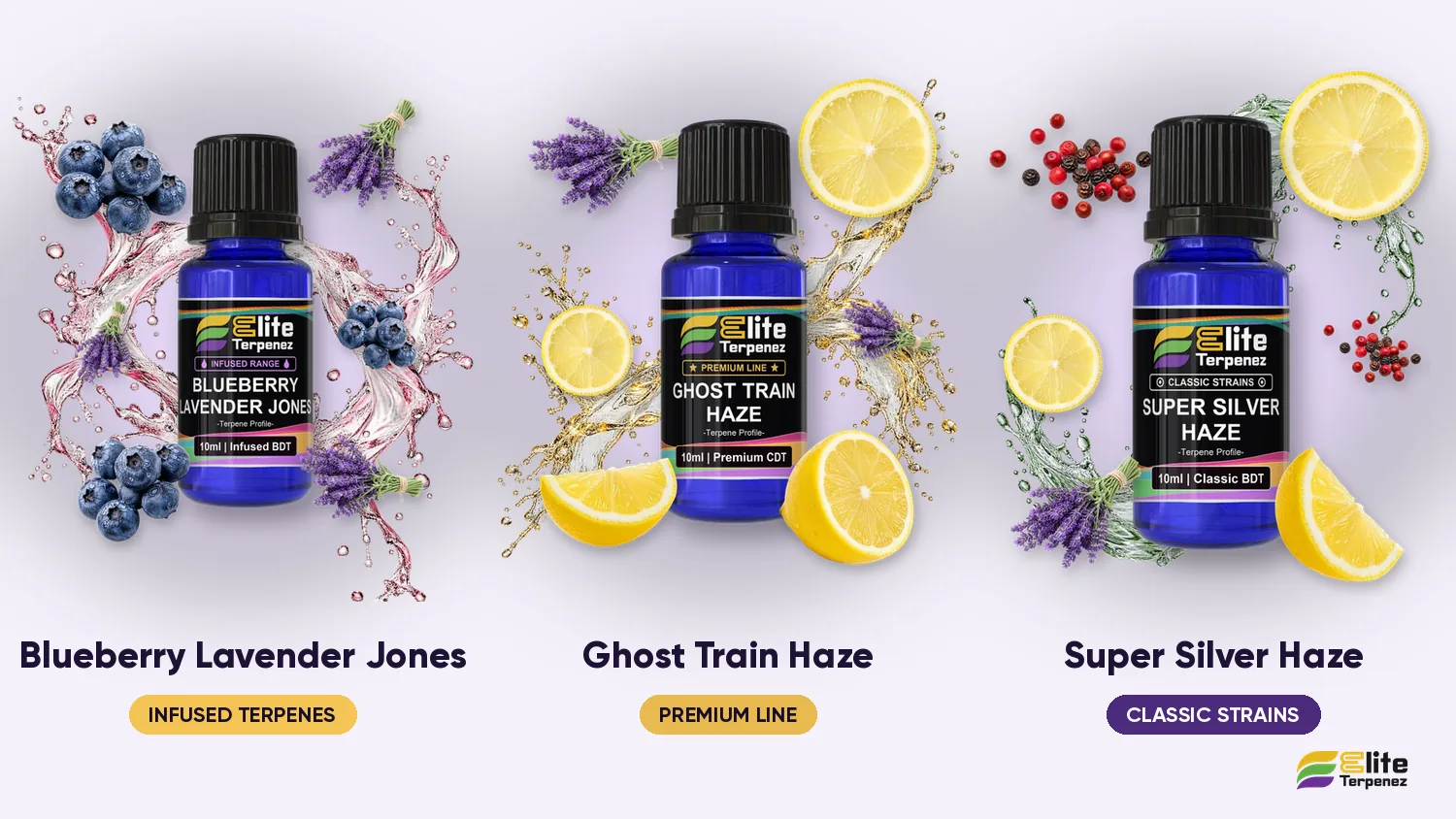
| Blueberry Lavender Jones | Infused Terpenes (BDT) | Sweet blueberry, soft lavender, floral jam |
| Ghost Train Haze | Premium Line (CDT) | Sweet, floral, citrus |
| Super Silver Haze | Classic Strains (BDT) | Earthy spice, sweet citrus, woody floral |
| Northern Lights | Classic Strains (BDT) | Sweet pine, warm spice, musky floral |
| AK-47 DNA | DNA Series | Earthy spice, sweet floral, sour edge |

For a clear lavender direction, start with Blueberry Lavender Jones. For a haze-style floral with citrus, look at Ghost Train Haze. For a woody, spiced floral, try Super Silver Haze or Northern Lights. Browse more in the Premium Line, Classic Strains and Infused Terpenes collections.
For cannabinoid content of any profile other than the Diamond Line, contact us and we will confirm before you order. Diamond Line terpenes contain no THC or other cannabinoids.
What does linalool pair with?
Linalool is a softener. It rounds off sharper notes and adds a clean lift to sweet, fruity and woody blends. Used as a guide to blending, these pairings are common:
- Berry and grape: a floral jam, as in a blueberry and lavender direction.
- Citrus: a bergamot or orange-blossom character.
- Pine and spice: a woody floral, like the classic haze and northern flavours.
- Dessert and cream: a delicate, perfumed finish over vanilla.
Floral notes are easy to over-use. A little goes a long way, and too much can turn soapy or perfumed instead of fresh. Start low, change one thing at a time, and re-smell the next day.
When you write a flavour brief, describe the floral note with a reference rather than a single word. “Soft lavender over blueberry jam” or “woody floral with citrus” gives a supplier and your own team something concrete to match. It also makes it easier to compare two profiles from different lines, because you are judging the same target each time instead of a vague idea of floral.
How do makers use linalool for flavour and aroma?
Makers use linalool-led floral profiles to add a soft, clean top note or a delicate finish to a blend. The same traits that make linalool a perfumer’s staple make it a flavourist’s tool: it is recognisable, gentle and pairs with almost everything.
Elite Terpenez’s starting cuts are 6% for vape cartridges, 4% for concentrates, 2% for tinctures, 1% for edibles, 0.5% for beverages and 3% for topicals. These are places to begin, not fixed rules. Terpene profiles are concentrated and must never be used undiluted. Use the terpene mixing calculator to turn a percentage into a weight, and always test a small batch first.
Handling and storage
PubChem’s classification reports list linalool as a skin and eye irritant that can cause an allergic skin reaction in some people, so wear gloves and eye protection and work in a ventilated space. Keep bottles away from children, pets, heat and flames. Store them tightly closed in a cool, dark place; refrigerated is ideal. For general workplace guidance, see the HSE’s COSHH basics. These products are for adults (18+) only.
PubChem lists linalool as stable under recommended storage conditions, but light, warmth and air still dull delicate floral notes over time. A bottle opened often and left half empty will lose freshness faster than a full, sealed one. Decant what you need, reseal quickly and write the opening date on the label. If a floral profile starts to smell flat or sharp, test a fresh bottle before you change your recipe.
Sizes and bulk
Profiles come in 2 ml, 5 ml and 10 ml bottles. For larger runs, ask about bulk on the wholesale and bulk page. Free UK delivery on orders over £80.

Frequently asked questions
What is linalool?
Linalool is a terpene alcohol with the formula C10H18O, found in lavender, coriander, basil, bergamot and many other plants. It is a colourless liquid with a floral, lavender-like smell, a CAS number of 78-70-6 and a boiling point of about 198 to 200 C. Makers use it as a flavour and aroma ingredient.
What does linalool smell like?
Linalool smells like fresh lavender blossom with a sweet, slightly woody and citrus-like lift. PubChem compares it with bergamot oil and French lavender. It is soft and clean rather than sharp, which is why it is used to round out blends in fragrance and flavour work.
Is linalool the same as lavender?
No. Linalool is one molecule, while lavender oil is a mixture of many. Linalool and linalyl acetate are its two main components, and one study found about 26.5% linalool in the oil of the whole flowering top. Lavender smells like lavender because of the combination, not linalool alone.
Where does linalool come from?
Linalool is found in lavender, coriander, basil, bergamot, rosewood, mint-family herbs and citrus peel, and in small amounts in many other plants, including cannabis flower. It can be obtained from natural plant oils or made by chemical synthesis. Amounts vary with plant variety, region and extraction method.
What is the difference between linalool and limonene?
Linalool is a floral terpene alcohol (C10H18O) that boils at about 198 to 200 C. Limonene is a citrus hydrocarbon (C10H16) that boils at about 175 to 178 C. Linalool smells of lavender blossom, limonene of orange and lemon peel. Orange peel oil contains both, with limonene far ahead.
Which Elite Terpenez profiles have a floral aroma?
Profiles with a floral note include Blueberry Lavender Jones, Ghost Train Haze, Super Silver Haze, Northern Lights and AK-47 DNA, across four lines. Each lists its own aroma notes on its product page. Elite Terpenez does not state the contents of its profiles, only their listed aroma notes and ingredients.
Which Elite Terpenez profiles are suggested for linalool, and what are their listed notes?
Start with Infused Terpenes Blueberry Lavender Jones (sweet blueberry, soft lavender, floral jam); Premium Line Ghost Train Haze (sweet, floral, citrus); Classic Strains Super Silver Haze (earthy spice, sweet citrus, woody floral). Notes come from each product page, and every profile is sold in 2 ml, 5 ml and 10 ml bottles.
Ready to add a floral note to your next flavour? Browse the Premium, Classic Strains and Infused ranges, order 2 ml samples, or contact us for bulk quantities and to confirm anything about a profile before you order.