










Key takeaways
- Myrcene is a C10H16 monoterpene (molecular weight 136.23, CAS 123-35-3) with a herbal, fruity, hoppy aroma.
- It boils at 166 to 167 °C and has a flash point of about 39 °C, so it is volatile and flammable and needs careful storage.
- It is a major aroma component of hops, bay and lemongrass, and is reported in some mango varieties and many strain flavours.
- Elite Terpenez sells profiles whose listed aroma notes are mango, tropical, herbal or earthy, in the Premium, Classic Strains, Infused and Flavour Catalogue ranges.
- Always dilute: a concentrated terpene is never used undiluted, and every new blend needs a small test batch first.
What is myrcene?
Myrcene is a monoterpene, which means it is built from two isoprene units and carries 10 carbon atoms. The form found in nature is beta-myrcene, with the systematic name 7-methyl-3-methylideneocta-1,6-diene. It is a simple, open-chain molecule with three double bonds, in contrast to the ring structures of limonene or caryophyllene.
That simple shape makes myrcene light and volatile. It evaporates quickly, mixes easily into oils and ethanol, and barely dissolves in water: PubChem lists a solubility of roughly 5.6 mg/L at 25 °C. In flavour and fragrance work it is used both as a finished aroma ingredient and, in industry, as a starting material for other fragrance chemicals.
When people say “myrcene” they almost always mean beta-myrcene. You may see the alpha form mentioned in older references, but it is not the compound found in plants and essential oils.
What does myrcene smell like?
PubChem describes myrcene as a yellow liquid with a pleasant, terpene-type odour, and lists its taste as sweet and citrus. Most people describe the smell as herbal and green with a fruity, slightly musky sweetness, somewhere between fresh hops, crushed bay leaf and ripe tropical fruit.
Because it is light, myrcene tends to read as a top-to-middle note. It gives a blend its first green, juicy impression, then gives way to heavier base notes such as pepper or wood. That is why myrcene-led strain flavours tend to feel fresh and fruity at first and earthy afterwards.
To learn the smell, crush a fresh bay leaf and compare it with the aroma of a hoppy beer. The shared green, resinous sweetness is largely myrcene.

Myrcene facts and chemistry
These are the key reference values for beta-myrcene from the PubChem compound record. Use them for planning and safe handling, not as a specification for any particular Elite Terpenez bottle.
| Property | Beta-myrcene |
|---|---|
| Molecular formula | C10H16 |
| Molecular weight | 136.23 g/mol |
| CAS number | 123-35-3 |
| Class | Acyclic monoterpene |
| Boiling point | 166 to 167 °C at 760 mmHg |
| Flash point | About 39 °C (103 °F) |
| Density | About 0.79 g/mL (floats on water) |
| Solubility | Very low in water, soluble in ethanol and oils |
| Odour | Herbal, fruity, hoppy |
The flash point is the figure makers should remember. At about 39 °C, myrcene gives off enough vapour to ignite at a temperature a warm room or a car dashboard can reach. That is why heat and flame warnings matter on every terpene bottle.
Where does myrcene occur in nature?
PubChem identifies myrcene as the major constituent of the essential oils of bay and hops, and notes it in lemongrass and verbena. Hops are the clearest everyday example: the herbal, resinous top note of a hoppy beer owes a lot to myrcene. It is also reported among the aroma volatiles of some mango varieties, although the amounts vary a great deal between varieties and ripeness, and other terpenes dominate in some types.
That last point is worth stating plainly, because “myrcene in mango” is a popular search. Mango aroma is a blend of dozens of volatile compounds, and myrcene is one contributor. It would be wrong to say a mango flavour is “all myrcene”, and Elite Terpenez does not claim any such thing about its mango profiles.
In strain flavours, myrcene is one of the terpenes commonly reported as dominant in lab tests of the flower, alongside caryophyllene and limonene. That is general knowledge about the plant, not a statement about the composition of any Elite profile. Elite Terpenez sells terpenes as flavour and aroma ingredients and makes no claims about effects.
How does myrcene compare with other common terpenes?
Myrcene is easiest to place next to the other terpenes makers handle most often. Boiling points are from the PubChem records.
| Terpene | Formula | Class | Boiling point (760 mmHg) | Typical aroma |
|---|---|---|---|---|
| Beta-myrcene | C10H16 | Acyclic monoterpene | 166 to 167 °C | Herbal, fruity, hoppy |
| Alpha-pinene | C10H16 | Bicyclic monoterpene | About 156 °C | Pine needles |
| Limonene | C10H16 | Cyclic monoterpene | About 176 °C | Fresh citrus peel |
| Linalool | C10H18O | Terpene alcohol | About 198 °C | Floral, lavender |
| Beta-caryophyllene | C15H24 | Sesquiterpene | About 256 to 259 °C | Black pepper, clove, wood |
Myrcene sits at the lighter end of the range, just above pinene. Its siblings limonene and pinene share the same formula, C10H16, which is a good reminder that two molecules with identical atoms can smell completely different when the atoms are arranged differently. For the citrus and spice ends of the palette, see our guides to limonene and caryophyllene.

Which strain flavours lean on myrcene’s aroma?
Strains known for mango, tropical fruit, herbal sweetness or soft berry tend to be the ones whose flavour people link to myrcene. Our guide to the Blue Dream strain is a good example, with its herbal, mellow base under the blueberry. Mango Kush, Maui Wowie, Green Crack and Pineapple Express are other classic names with fruity, tropical or herbal aroma notes.
These are descriptions of the flavour each strain is known for. Cannabis flower is a controlled drug in the UK and Elite Terpenez does not sell cannabis.
Which Elite Terpenez profiles have a mango, tropical or herbal aroma?
Elite Terpenez does not publish a percentage breakdown for its profiles, and we will not say a profile “contains X% myrcene”. What we can do is point to profiles whose listed aroma notes are mango, tropical or herbal, which is where a myrcene-style character shows up.
| Profile | Line | Listed aroma notes |
|---|---|---|
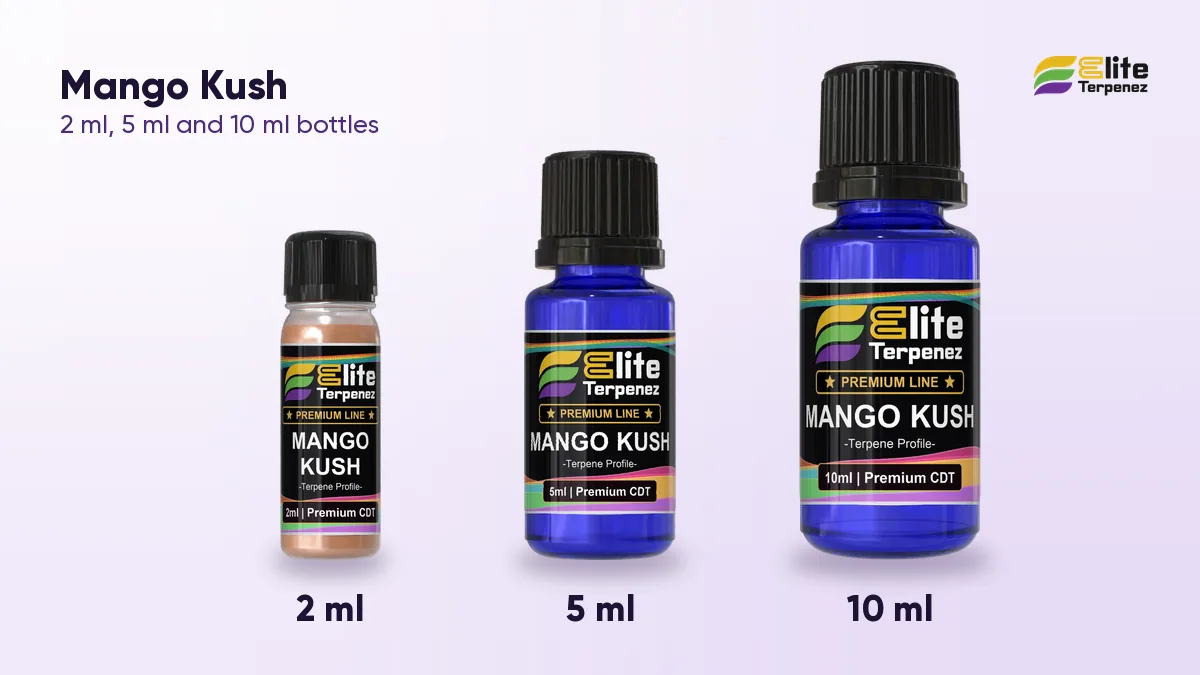
| Mango Kush | Premium Line (CDT) | Tropical, fruity, sweet |
| Maui Wowie | Premium Line (CDT) | Tropical, fruity, herbal |
| Green Crack | Classic Strains (BDT) | Zesty mango, bright citrus, sweet pine |
| Mango Kush | All Natural Infused (BDT) | Juicy ripe mango, woody kush base, sweet tropical finish |
| Mango Skunk | Infused Terpenes (BDT) | Juicy mango, earthy skunk, sweet funk |

For a more herbal direction, the Premium Line Afgoo lists herbal, woody and spice notes, and Blue Dream (Premium Line) lists sweet, berry and herbal. Browse the Premium Line, the Classic Strains and the All Natural Infused collections to find more fruity and herbal profiles. For other lines, contact us and we will confirm any questions before you order.
How is a mango flavour built from terpenes?
A convincing mango flavour is a layered build rather than a single molecule. The juicy, tropical top comes from fruity and green terpene character, the sweetness comes from fruit and flavouring notes, and a small amount of woody or piney base gives the flavour a ripe, rounded finish. That is why the Elite mango profiles list more than just “mango”: Green Crack adds bright citrus and sweet pine, and Mango Kush adds a woody kush base.
The practical lesson for makers is to choose a mango profile by its supporting notes. A mango with citrus suits a drink or a bright product. A mango with a woody or earthy base suits a product where you want the fruit to feel grounded rather than sugary.
How do myrcene-style and citrus-style profiles differ in a blend?
Myrcene-style profiles are green, juicy and slightly musky, while citrus-style profiles are sharp, bright and clean. Used together they cover most of the top-note range: the citrus gives sparkle and the green, fruity note gives body. Used separately, a citrus-only blend can feel thin and a mango-only blend can feel heavy.
- Mostly tropical, a little citrus: a rounded, juicy result that keeps the fruit in front.
- Mostly citrus, a little tropical: a sharper result with a softer, fruitier finish.
- Tropical plus a peppery base: a grounded, warm result with more structure.
As always, start with the smaller share, record each trial and change one variable at a time. Small differences in ratio change the result more than most people expect.
How do makers use myrcene-style flavours?
Mango and tropical profiles are popular as a base for fruit-forward products because the flavour is instantly recognisable. A common approach is to start with a single mango or tropical profile, then add a small amount of a citrus profile for brightness or a spicier profile for depth.
Elite Terpenez profiles are concentrated and are never used undiluted. The terpene mixing calculator uses these starting cuts: vape cartridges 6%, concentrates 4%, tinctures 2%, edibles 1%, beverages 0.5% and topicals 3%. Treat them as a starting point only and test a small batch first.
Light, fruity top notes also fade first when a blend is stored warm or left open, so judge your trial blend after it has rested for a short time, not only straight after mixing. Record each change and compare against your first version.

How should myrcene-rich profiles be handled and stored?
Myrcene’s low flash point means bottles should be treated as flammable liquids. Wear gloves and eye protection, work in a ventilated space, and keep bottles away from children, pets, heat and flames. Store tightly closed in a cool, dark place; refrigerated is ideal. Light terpenes lose their fresh top notes first when exposed to air and warmth. If a bottle has been opened many times, decant what you need into a smaller clean container rather than leaving a large air gap above a fruity, volatile profile, and always label any decanted container clearly.
For the rules on classifying and labelling chemical products supplied in Great Britain, see the Health and Safety Executive’s chemical classification and labelling guidance. The molecule data in this article comes from the PubChem record for myrcene and the record for alpha-pinene. Our What are terpenes? guide explains the wider families.
Frequently asked questions
What is myrcene?
Myrcene, or beta-myrcene, is an acyclic monoterpene with the formula C10H16 and CAS number 123-35-3. It has a herbal, fruity, slightly musky aroma and occurs in hops, bay leaf, lemongrass and some mango varieties. It is used as a flavour and aroma ingredient.
What does myrcene smell like?
Myrcene smells herbal and green with a fruity, slightly musky sweetness, somewhere between fresh hops, crushed bay leaf and ripe tropical fruit. PubChem describes the odour as pleasant and terpene-like and lists the taste as sweet and citrus. It usually reads as a top-to-middle note.
What is the boiling point of myrcene?
The PubChem record lists a boiling point of 166 to 167 °C at normal atmospheric pressure. That is lighter than limonene (about 176 °C) and much lighter than caryophyllene (about 256 to 259 °C), so myrcene evaporates quickly and its fresh notes fade first if a bottle is left open.
Is myrcene found in mango?
Myrcene is reported among the aroma volatiles of some mango varieties, but the amount varies widely between varieties and ripeness, and other terpenes dominate in some types. Mango aroma is a blend of many compounds, so a mango flavour is never simply myrcene.
Where else is myrcene found?
PubChem identifies myrcene as a major constituent of bay and hop essential oils, and it is present in lemongrass and verbena. It is also reported in many strain flavours. Because it is so widespread, it matters in everything from hop aroma to fragrance work.
Is myrcene flammable?
Yes. Myrcene has a flash point of about 39 °C, so its vapour can ignite at fairly modest temperatures. Treat every terpene bottle as a flammable liquid: keep it away from heat and flames, store it cool and tightly closed, wear gloves and eye protection, and never use a concentrated terpene undiluted.
Where can I buy mango and tropical terpene profiles in the UK?
Elite Terpenez sells mango, tropical and herbal terpene profiles for adult product makers in 2 ml, 5 ml and 10 ml bottles, with bulk on request. Browse the Premium, Classic Strains and Infused ranges, or contact us for advice. Free UK delivery on orders over £80.
Ready to build with a fruity, herbal top note? Compare the Mango Kush and Maui Wowie profiles side by side, or ask about larger quantities through our wholesale and bulk page. Sizes start at 2 ml, with free UK delivery on orders over £80.