









Key takeaways
- Alpha-bisabolol is a monocyclic sesquiterpene alcohol, C15H26O, with a molecular weight of 222.37 g/mol.
- The natural form is (-)-alpha-bisabolol, also called levomenol, and it is the main component of German chamomile essential oil.
- It smells weakly sweet and floral, often described as honeyed, fruity, nutty or apple-like, and it is a quiet, soft aroma rather than a loud one.
- It boils at about 314 C and is practically insoluble in water, so it is a heavy, slow-evaporating terpenoid.
- Elite Terpenez sells soft floral and honeyed profiles in several lines. Their listed aroma notes describe the smell, not the contents.
- Never use a concentrated terpene undiluted. Test a small batch first and work from the calculator’s starting cuts.
What is bisabolol?
Bisabolol is a colourless, slightly viscous oil made of fifteen carbon atoms. Chemists call it a monocyclic sesquiterpene alcohol: it is built from three isoprene units, contains one ring, and carries an alcohol group. The most common form is alpha-bisabolol, with the formula C15H26O and a molecular weight of 222.37 g/mol, according to PubChem’s alpha-bisabolol record.
Compared with limonene or pinene, bisabolol has five extra carbon atoms, which makes it heavier, less volatile and gentler on the nose. It is a sesquiterpene, the same family as caryophyllene, rather than a lighter monoterpene.
If you are new to the topic, our guide to what terpenes are covers the basics before the detail below.
What is the difference between bisabolol, alpha-bisabolol and levomenol?
These names overlap, and suppliers use them loosely. Bisabolol is the general name for a small family of related molecules. Alpha-bisabolol is the most common member. Levomenol is the specific left-handed (-)-alpha-bisabolol that occurs naturally in chamomile. The right-handed (+) form is rare in nature, and synthetic bisabolol is usually a mix of the two forms.
- Alpha-bisabolol: CAS 515-69-5 in most supplier listings, covering the general or mixed form.
- Levomenol, (-)-alpha-bisabolol: CAS 23089-26-1, the natural form found in German chamomile, with its own PubChem record.
- Beta-bisabolol: a related molecule where the alcohol group sits in a different position, with its own CAS number.
Because PubChem and suppliers sometimes list different CAS numbers for the same material, check the number and the stated form on the specification sheet rather than relying on the word “bisabolol” alone.
What does bisabolol smell like?
Bisabolol smells mild, sweet and floral. The Good Scents Company, a fragrance reference, describes it as a low-strength floral, peppery and balsamic note, and PubChem records a fruity, nutty aroma with hints of coconut. Many descriptions also mention honey, apple and sugar. It is the molecule behind the soft, sweet smell of fresh chamomile flowers.
How a bisabolol-led aroma reads depends on what sits beside it:
- Alone: a faint, clean floral with a honeyed sweetness.
- With fruit notes: a softer, rounder, almost apple-and-honey sweetness.
- With citrus notes: a gentle floral base under a bright lemon top.
- With creamy or coconut notes: a smooth, tropical-floral impression.
Where is bisabolol found in nature?
Bisabolol occurs in German chamomile, where it is the primary constituent of the essential oil, and in a range of other plants. The Wikipedia entry on bisabolol names German chamomile (Matricaria recutita) and Myoporum crassifolium as notable sources, and PubChem lists it in many other species, including some conifers and Artemisia.
Natural amounts vary with plant variety, region, season and extraction method, so there is no single figure for how much any one plant holds. Bisabolol is a minor, sometimes trace, constituent of many plant oils, and it is also made by industry from other raw materials for use as an ingredient.
It also appears in some cannabis cultivars, though usually among the less common terpenes in lab reports. Because it is quiet and heavy, it rarely leads a profile; it adds roundness and a soft floral base.
What are the key facts about bisabolol?
The table below puts alpha-bisabolol next to three other terpenes so you can compare the numbers. Data comes from PubChem records and a fragrance reference, and boiling points are rounded.
| Molecule | Class | Formula | CAS number | Boiling point | Aroma |
|---|---|---|---|---|---|
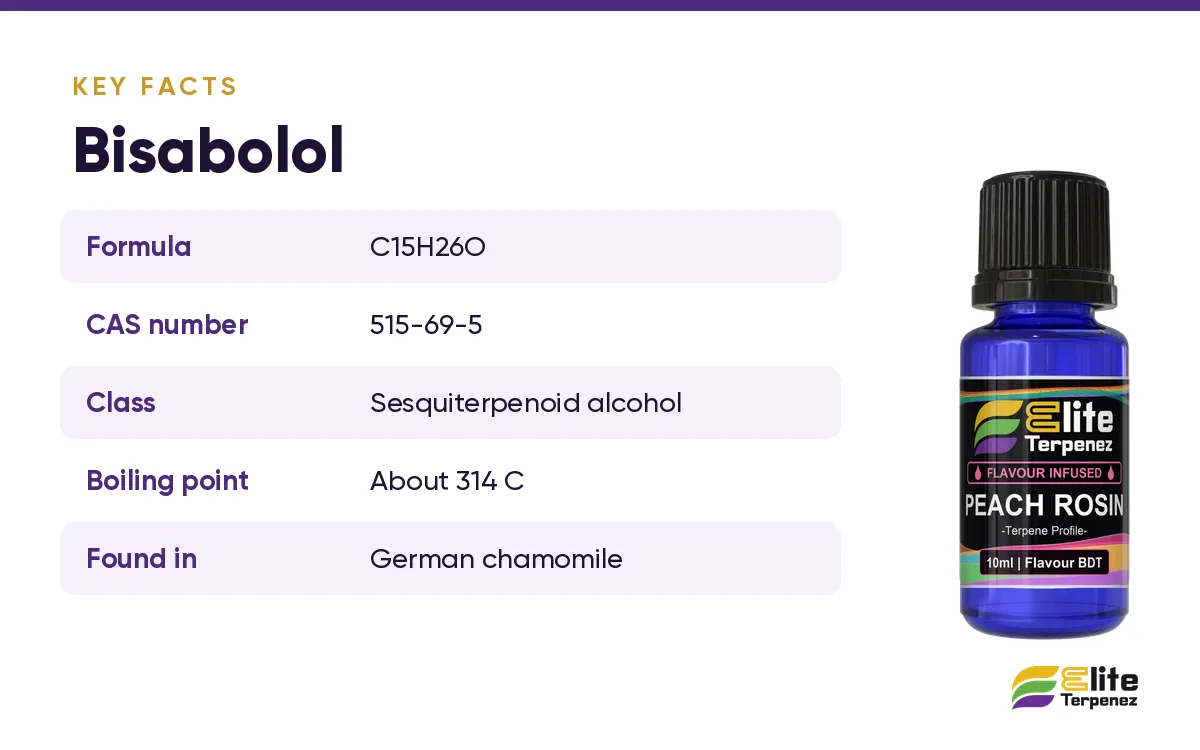
| Alpha-bisabolol | Sesquiterpenoid (alcohol) | C15H26O | 515-69-5 (levomenol 23089-26-1) | About 314 C | Mild, sweet, floral, honeyed |
| Beta-caryophyllene | Sesquiterpene | C15H24 | 87-44-5 | About 256 to 259 C | Peppery, woody, spicy |
| Geraniol | Monoterpenoid (alcohol) | C10H18O | 106-24-1 | About 229 to 230 C | Sweet rose |
| Linalool | Monoterpenoid (alcohol) | C10H18O | 78-70-6 | About 198 C | Floral, lavender-like |
A few more figures help with handling. Alpha-bisabolol has a density of about 0.92 to 0.93 g/mL, so it floats on water, and a listed closed-cup flash point of around 135 C. It is practically insoluble in water but soluble in ethanol and in oils. Because it boils far above lighter terpenes, it stays in a blend long after they have gone.
How is bisabolol different from other floral terpenes?
Bisabolol is a floral note, but a very different one from the lighter alcohols. Geraniol, covered in our geraniol guide, is a louder, rosy floral. Linalool is a lighter, lavender-like floral. Bisabolol is quieter and sweeter, with honeyed and fruity overtones, and it has far less lift because it is heavier.
That weight is useful. Light terpenes give the opening burst, while a heavy terpenoid like bisabolol sits underneath and rounds off the finish. It also pairs naturally with other alcohol-type terpenoids such as borneol, which our borneol guide describes as camphor-like and woody.
How is bisabolol sourced and used?
Commercial bisabolol is obtained from plant oils that are rich in it, or made synthetically, and is then purified to a specification. It is a long-established ingredient in the fragrance and cosmetics industries, which is why it is easy to find in supplier catalogues. PubChem also lists alpha-bisabolol among flavouring agents. Elite Terpenez makes no claims about skin or any other use of bisabolol beyond flavour and aroma.
In flavour and aroma work, bisabolol reaches a finished profile in one of three ways:
- Isolated or purified: the single molecule, used as a soft floral building block.
- Present in a whole plant extract: bisabolol alongside the other molecules the plant made, as in cannabis-derived terpenes (CDTs).
- Present in a botanical blend: bisabolol combined with other botanical-derived terpenes (BDTs) to recreate a target aroma.
Which route suits you depends on whether you want one clean floral note or a layered, natural-smelling profile. A layered profile usually smells more natural, while an isolated note is more predictable.
Which Elite Terpenez profiles have a soft floral or honeyed aroma?
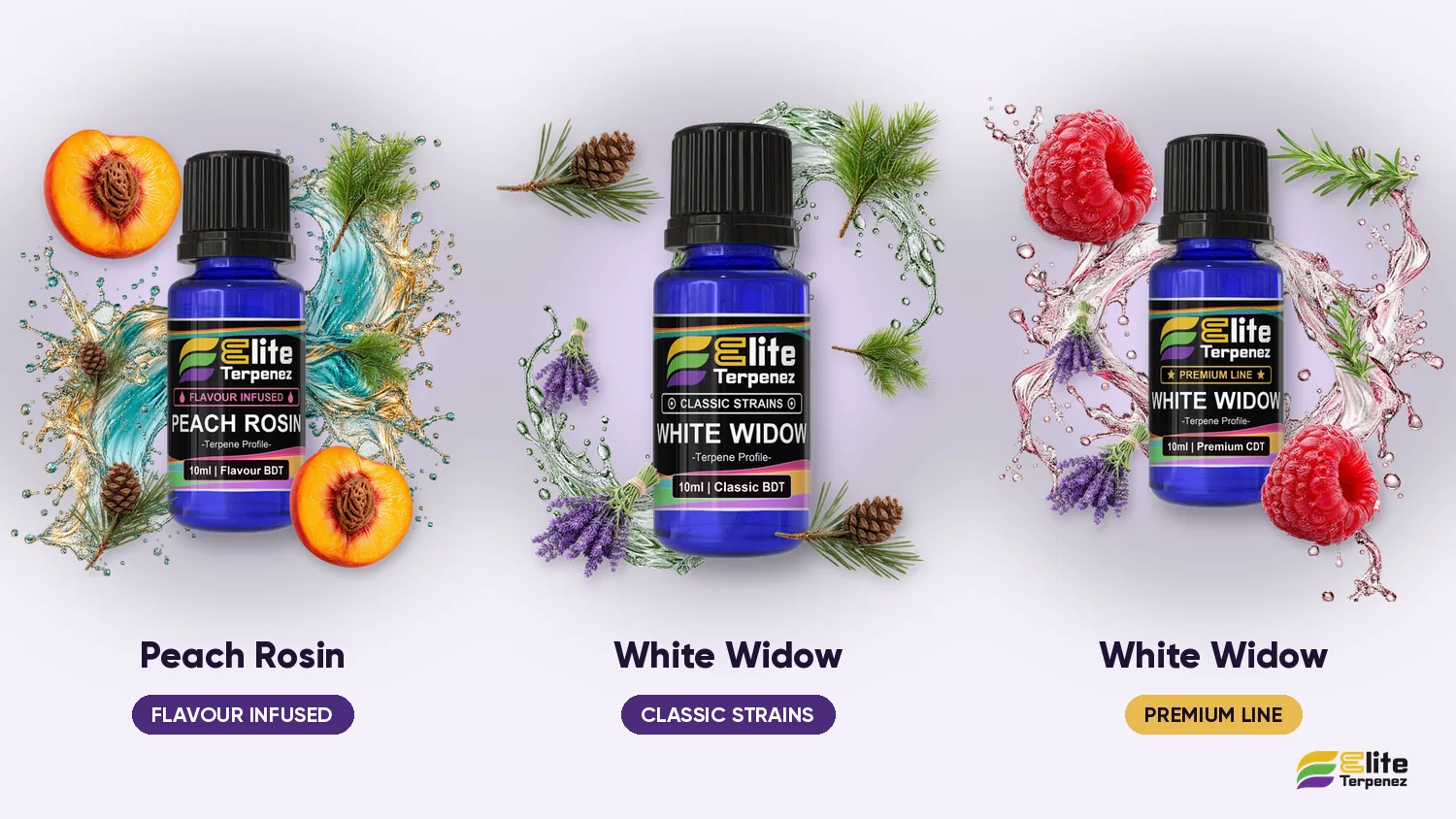
Elite Terpenez sells many profiles with soft floral and honeyed notes, across the Flavour Infused, Classic Strains and Premium lines. We do not state the contents of any profile, so the table shows each profile’s listed aroma notes only. Profiles with a soft floral or honeyed aroma such as these are a good place to start:
| Profile | Line | Listed aroma notes |
|---|---|---|
| Peach Rosin | Flavour Infused (BDT) | Sweet ripe peach, soft honey, light resin finish |
| Juicy Red Apple | Flavour Infused (BDT) | Crisp red apple, juicy sweetness, honeyed finish |
| White Widow | Classic Strains (BDT) | Earthy wood, sweet pine, soft floral |
| White Widow | Premium Line (CDT) | Berry, herbal, floral |
| Honeydew Boo | Flavour Infused (BDT) | Sweet honeydew, soft and fragrant, light creamy finish |
For a honeyed fruit direction, start with Peach Rosin or Juicy Red Apple. For a soft floral in a strain-style profile, look at the two White Widow profiles. To browse more, see the Flavour Infused, Classic Strains and Premium Line collections, or the full Flavour Catalogue.
For cannabinoid content of any profile other than the Diamond Line, contact us and we will confirm before you order. Diamond Line terpenes contain no THC or other cannabinoids.
What does bisabolol pair with?
Bisabolol is a supporting player, and most popular flavours that use a soft floral base are fruit or cream layered over it. Use these pairings as a guide when you plan a blend or choose between profiles:
| Pair bisabolol with | Resulting impression | Example listed aroma notes |
|---|---|---|
| Peach and honey | Orchard fruit with a honeyed finish | Peach Rosin: sweet ripe peach, soft honey, light resin finish |
| Apple | Crisp fruit with a soft sweetness | Juicy Red Apple: crisp red apple, juicy sweetness, honeyed finish |
| Coconut and cream | Smooth, tropical-floral dessert | Coconut Cream: silky coconut, sweet vanilla, light tropical finish |
| Berry and herbs | Floral with a green edge | White Widow: berry, herbal, floral |
These are separate profiles from the Elite range, each with its own listed notes. They show the direction of the pairing and say nothing about what any bottle contains.
How do makers use bisabolol for flavour and aroma?
Makers use soft floral and honeyed profiles to give a product a smooth, rounded finish. A gentle floral base is popular in beverages, confectionery-style flavours and topicals, where a loud floral would be too much. It also pairs easily with fruit, cream and honey notes.
A few practical points:
- Expect subtlety: bisabolol is a quiet aroma, so its role is usually to round off a blend, not to lead it.
- Build, do not stack: pair a soft floral profile with fruit or cream to avoid a flat, single-note result.
- Test small: run a small batch, wait a day, and re-smell it before scaling.
- Mix well: a heavy, viscous terpenoid can sit at the bottom of a blend, so mix thoroughly.
What are the starting cuts and handling rules?
Terpene profiles are concentrated and must never be used undiluted. Elite Terpenez’s starting cuts are 6% for vape cartridges, 4% for concentrates, 2% for tinctures, 1% for edibles, 0.5% for beverages and 3% for topicals. Use the terpene mixing calculator to turn a percentage into a weight, and always test a small batch first.
Bisabolol has a notable hazard profile. PubChem’s classification lists it as a possible skin sensitiser, and as toxic to aquatic life over the long term, so it should not be poured down a drain. Wear gloves and eye protection, keep it away from children, pets, heat and flames, and work in a ventilated space. For general workplace guidance, see the HSE’s COSHH basics. Products are for adults (18+) only.
Storage
Store terpene bottles tightly closed in a cool, dark place; refrigerated is ideal. Light, warmth and air speed up oxidation, so a half-empty bottle left open will lose its freshness faster than a full, closed one. Decant what you need and reseal promptly.
If a floral profile starts to smell flat or off rather than soft and sweet, it has probably aged, and it is better to test a fresh bottle than to adjust your recipe to compensate. Label the date you opened each bottle so you can track how long it has been in use.
Sizes and bulk
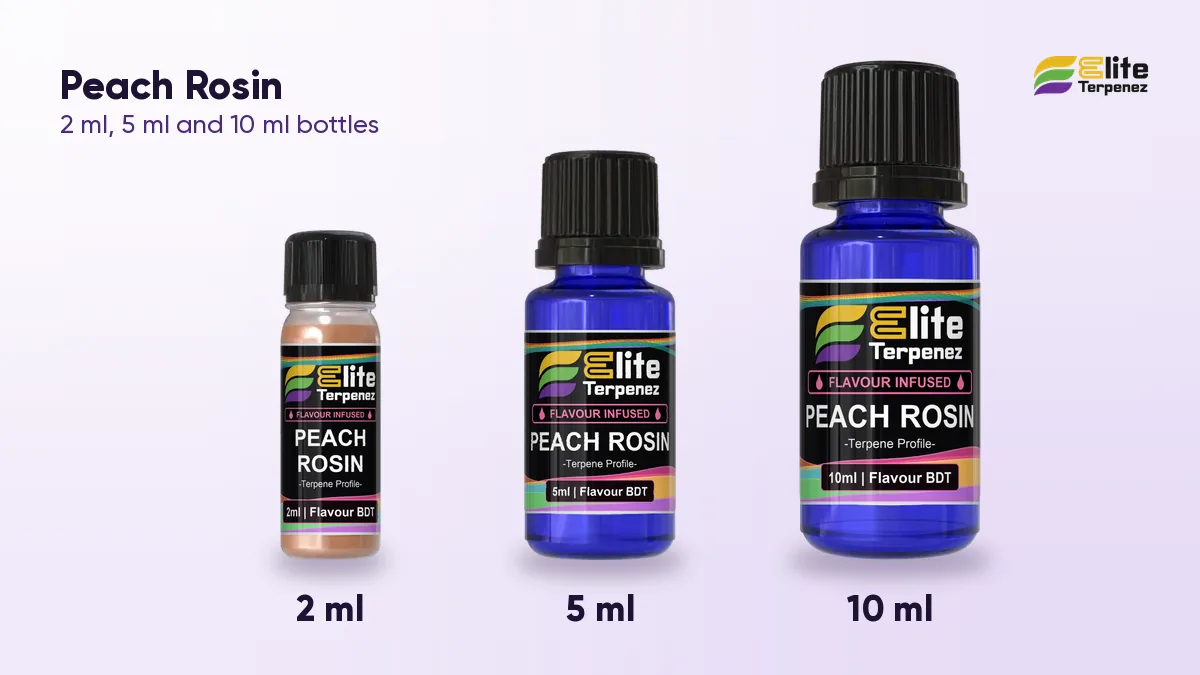
Profiles come in 2 ml, 5 ml and 10 ml bottles. For larger runs, ask about bulk on the wholesale and bulk page. Free UK delivery on orders over £80.
Frequently asked questions
What is bisabolol?
Bisabolol is a monocyclic sesquiterpene alcohol with the formula C15H26O, best known as the main aroma molecule of German chamomile. Alpha-bisabolol is the most common form, with CAS number 515-69-5 and a boiling point of about 314 C. Makers use it as a flavour and aroma ingredient.
What is the difference between bisabolol and alpha-bisabolol?
Bisabolol is the family name and alpha-bisabolol is its most common member. The natural left-handed form is called levomenol, or (-)-alpha-bisabolol, with CAS number 23089-26-1. Supplier listings often use the names loosely, so check the CAS number and stated form on the specification sheet.
What does bisabolol smell like?
Bisabolol smells mild, sweet and floral, often described as honeyed, fruity, nutty or apple-like. It is the molecule behind the soft smell of chamomile flowers. It is a quiet aroma that rounds off a blend rather than leading it, because it is a heavy, slow-evaporating terpenoid.
Where does bisabolol come from?
Bisabolol is the main constituent of German chamomile essential oil and occurs in smaller amounts in many other plants. Commercially it is obtained from plant oils rich in it or made synthetically. Natural amounts vary with plant variety, region and extraction method.
Is bisabolol used in cosmetics?
Yes, bisabolol is a long-established ingredient in the fragrance and cosmetics industries. That is an industry fact only. Elite Terpenez sells terpenes as flavour and aroma ingredients and makes no claims about skin or any other use. PubChem lists it as a possible skin sensitiser, so wear gloves when handling.
Which Elite Terpenez profiles have a soft floral or honeyed aroma?
Profiles with a soft floral or honeyed aroma include Peach Rosin, Juicy Red Apple, Honeydew Boo and two White Widow profiles, across three lines. Each lists its own aroma notes on its product page. Elite Terpenez does not state the contents of its profiles, only their listed aroma notes and ingredients.
Which Elite Terpenez profiles are suggested for bisabolol, and what are their listed notes?
Start with Flavour Infused Peach Rosin (sweet ripe peach, soft honey, light resin finish); Classic Strains White Widow (earthy wood, sweet pine, soft floral); Premium Line White Widow (berry, herbal, floral). Notes come from each product page, and every profile is sold in 2 ml, 5 ml and 10 ml bottles.
Ready to build a soft floral flavour? Browse the Flavour Infused, Classic Strains and Premium ranges, order samples in 2 ml bottles, or contact us for bulk quantities and to confirm anything about a profile before you order.