










Key takeaways
- Citral is not one molecule but a mixture of geranial (citral A) and neral (citral B), both C10H16O with a molecular weight of 152.23 g/mol.
- It is a terpene aldehyde, which makes it different from limonene, a hydrocarbon. Citral gives the sharp, sweet lemon-candy smell, while limonene gives orange and lemon peel.
- Lemon myrtle oil is made up of roughly 80 to 97% citral, lemongrass oils roughly 60 to 90%, and cold-pressed lemon oil only about 2 to 3%.
- PubChem lists citral as a skin irritant that can cause an allergic skin reaction, so gloves and eye protection matter.
- Elite Terpenez sells lemon-led profiles in several lines. Their listed aroma notes describe the smell, not the contents.
- Never use a concentrated terpene undiluted. Test a small batch first and work from the calculator’s starting cuts.
What is citral?
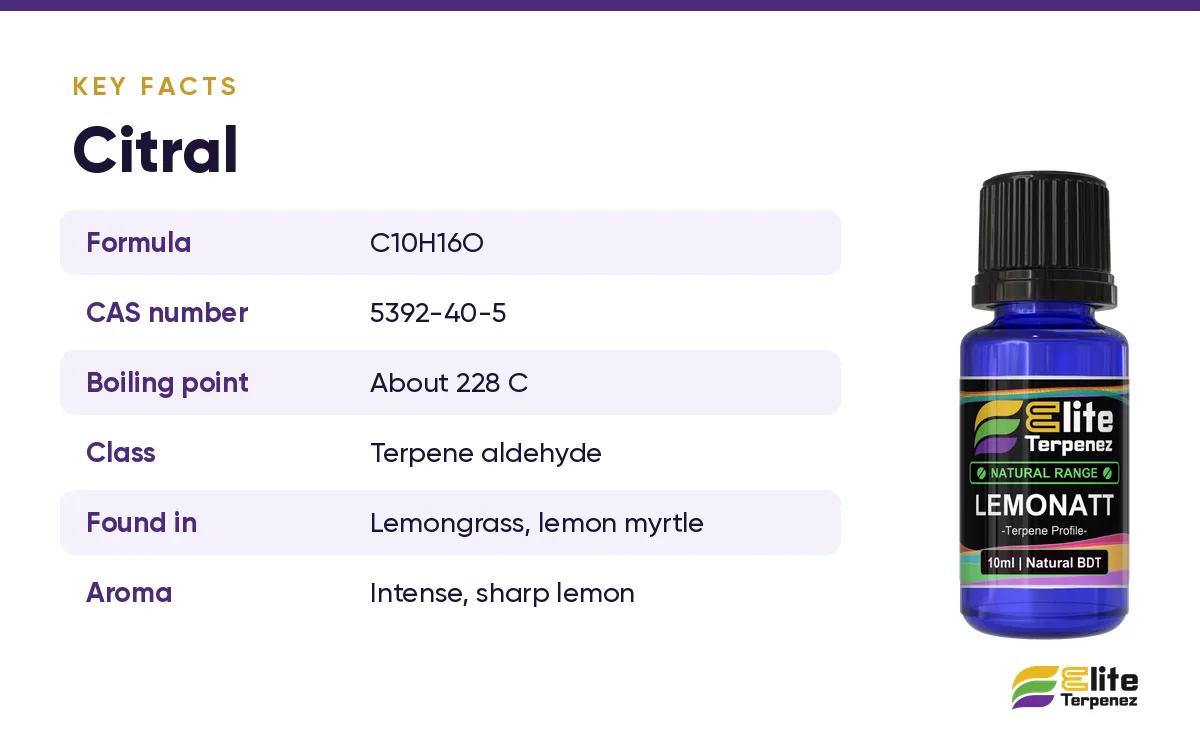
Citral is a pale yellow liquid with one of the most recognisable lemon smells in flavour and fragrance work. Chemically it is a monoterpenoid aldehyde with ten carbon atoms, the formula C10H16O and a molecular weight of 152.23 g/mol, according to PubChem’s citral record.
Early chemists thought citral was a single compound. It is actually a mixture of two geometric isomers: geranial (also called trans-citral or citral A) and neral (cis-citral or citral B). They share a formula and differ only in the way one double bond is arranged. In plant oils geranial usually slightly outweighs neral, and suppliers sell the pair together under the name citral.
Citral is made by plants as part of their essential oil. If you are new to the topic, our guide to what terpenes are covers the basics before the detail below.
What does citral smell like?
Citral smells of intense, fresh lemon. PubChem records its odour as a lemon odour, and many people describe it as lemon sweets, lemon zest or lemongrass. It is sharper and more candy-like than the peel-oil smell of limonene, with a slight green, herbal edge.
The aroma is also very easy to detect. PubChem lists taste detection thresholds for citral in the range of about 28 to 120 parts per billion, which is why a very small amount is enough to make a lemon note obvious. The practical lesson is to measure carefully and start low.
In a finished aroma, citral behaves like this:
- Top: a sparkling lemon zest that fades first.
- Middle: sweet lemon-candy and a green, grassy lift.
- Base: very little, so it needs partners such as cream, vanilla or fuel notes to hold the blend together.
What are the key facts about citral?
The table below puts citral next to three other lemon- and rose-smelling terpenes so you can compare the numbers. Data comes from PubChem records for each molecule.
| Compound | Class | Formula | CAS number | Boiling point | Aroma |
|---|---|---|---|---|---|
| Citral | Monoterpenoid aldehyde | C10H16O | 5392-40-5 (geranial 141-27-5) | About 228 C | Intense, sharp lemon |
| Citronellal | Monoterpenoid aldehyde | C10H18O | 106-23-0 | About 206 C | Lemon, citronella, rose |
| Geraniol | Monoterpenoid alcohol | C10H18O | 106-24-1 | About 230 C | Sweet rose, geranium |
| Limonene | Cyclic monoterpene | C10H16 | 138-86-3 | About 175 to 178 C | Citrus peel, orange, lemon |
For handling, citral has a density of about 0.89 g/mL, so it floats on water, and a closed-cup flash point of around 82 to 91 C depending on the source. It is only slightly soluble in water, but mixes with ethanol, propylene glycol and oils. PubChem notes that it decomposes near its boiling point, so it is not something to heat hard.
Where is citral found in nature?
Citral occurs in a handful of plants whose leaves or fruit smell intensely of lemon. A peer-reviewed review of lemon myrtle in the journal Foods compares the main natural sources and gives these ranges for citral as a share of the essential oil:
| Source | Citral share of the oil |
|---|---|
| Lemon myrtle (Backhousia citriodora), leaves | About 80 to 97% |
| Lemongrass (Cymbopogon citratus), leaves | About 73 to 90% |
| Lemongrass (Cymbopogon flexuosus), leaves | About 60 to 90% |
| May chang (Litsea cubeba), fruit | About 63 to 78% |
| Lemon verbena (Aloysia triphylla), leaves | About 43 to 68% |
| Cold-pressed lemon oil (Citrus limon), peel | About 2 to 3% |
The point of the table is the last row. Lemon oil smells of lemon, but most of that smell comes from limonene and other components, with citral as a small but powerful contributor. Lemongrass and lemon myrtle are the sources where citral is the main ingredient. You can read the original figures in the review on PubMed Central.
These numbers come from published surveys, and oils vary with variety, region and extraction method, so treat them as typical ranges and not guarantees. Citral is also reported in smaller amounts in other plants, including some citrus peels and herbs.
How is citral different from limonene and geraniol?
Limonene is a hydrocarbon and the main citrus peel note. Citral is an aldehyde, which makes it more reactive and gives it that sharp lemon-candy edge. Smell a fresh orange peel and you smell limonene; smell crushed lemongrass or lemon myrtle leaf and you smell citral.
Geraniol, covered in our geraniol guide, is the alcohol cousin. Citral and geraniol share the same carbon skeleton, and in nature the plant can convert one into the other. Where citral smells of lemon, geraniol smells of rose and geranium.
That relationship is why flavourists often work with them together. A lemon with a touch of rose reads as softer and more perfumed, while citral on its own can come across as sharp or even soapy if the dose is too large.
How is citral sourced?
Citral reaches a finished flavour or aroma profile by one of three routes:
- Isolated from essential oils: the oil of lemongrass or Litsea cubeba is distilled and fractionated to give a citral-rich ingredient. Commercial citral is also made by synthesis.
- Present in a whole plant extract: citral alongside the other terpenes the plant made, as in cannabis-derived terpenes (CDTs).
- Present in a botanical blend: citral-style notes combined with other botanical-derived terpenes (BDTs) to recreate a target lemon aroma.
Which route suits you depends on whether you want one clean lemon note or a layered, strain-like profile. A layered profile usually smells more natural, while an isolated lemon note is more predictable from batch to batch.
Which Elite Terpenez profiles have a lemon-led aroma?
Elite Terpenez sells many profiles with a lemon-led aroma across the Natural, Flavour Infused, Classic Strains, Diamond and Infused lines. We do not state the contents of any profile, so the table shows each profile’s listed aroma notes only. Profiles with a lemon-led aroma such as these are a good place to start:
| Profile | Line | Listed aroma notes |
|---|---|---|
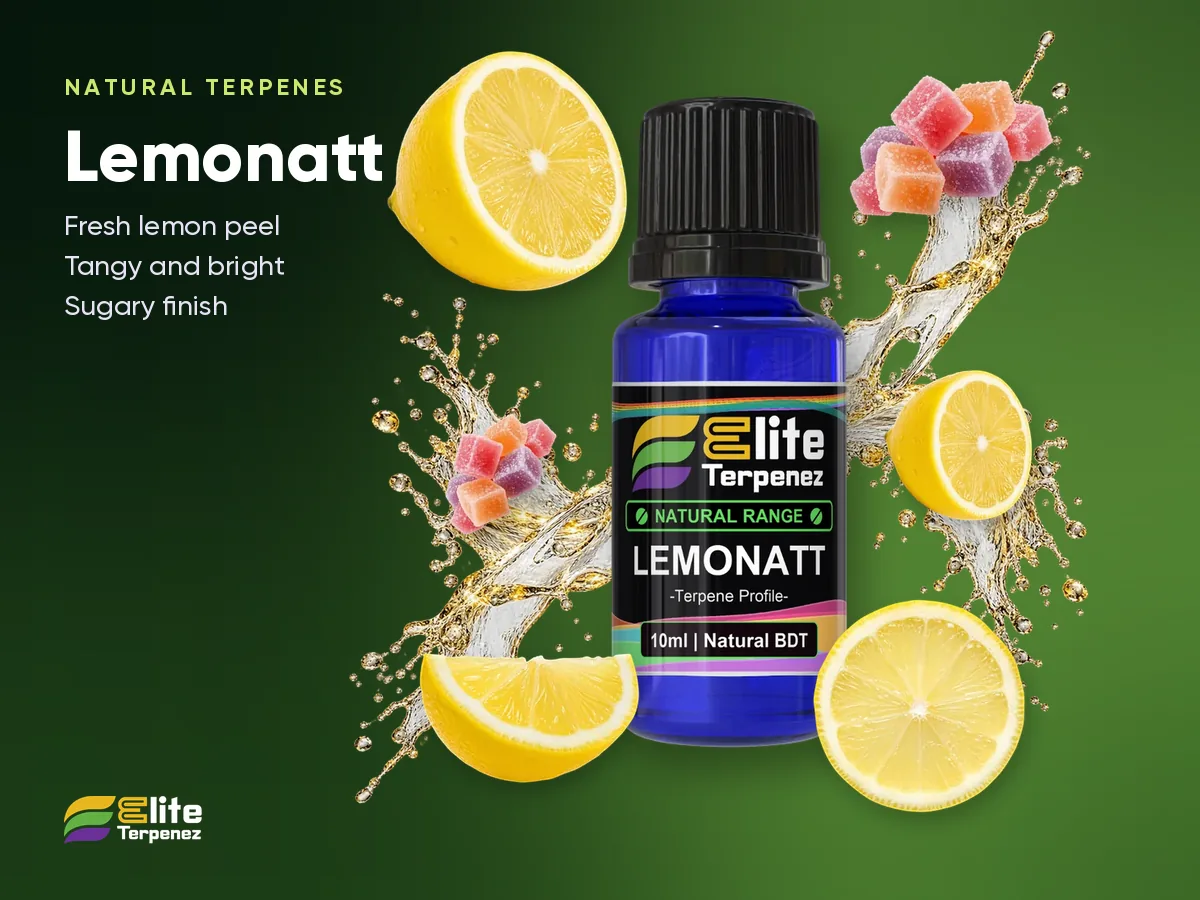
| Lemonatt | Natural Terpenes (BDT) | Fresh lemon peel, tangy and bright, sugary finish |
| Summer Lemon | Flavour Infused (BDT) | Sun-bright lemon, sweet and zesty, crisp finish |
| Lemon Cherry Gelato | Diamond Line (CDT) | Lemon peel, cherry, vanilla, earthy cake |
| Lemon Limeade | Infused Terpenes (BDT) | Tangy lime, sharp lemon, sweet limeade |
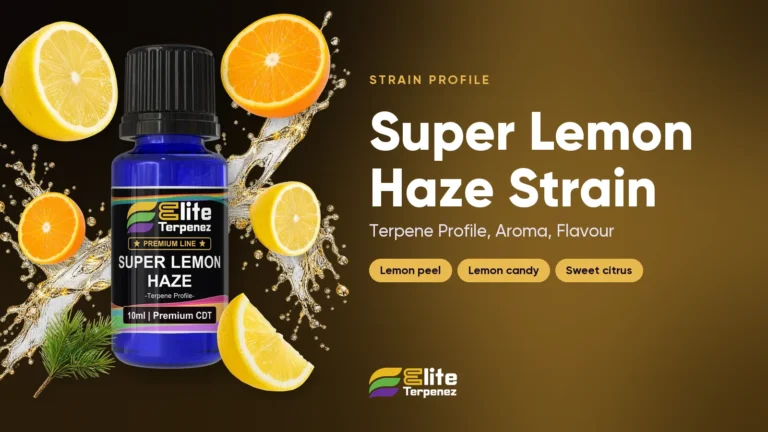
| Lemon Sour Diesel | Premium Line (CDT) | Citrus, sour, diesel |

For a bright, candy-like lemon, start with Lemonatt or Summer Lemon. For lemon with dessert sweetness, look at Lemon Cherry Gelato, which we cover in our Lemon Cherry Gelato strain guide. For lemon with a fuel edge, Lemon Sour Diesel is the match, and our Sour Diesel strain guide explains that family. To browse more, see the Natural Terpenes and Flavour Infused collections, or the full Flavour Catalogue.
For cannabinoid content of any profile other than the Diamond Line, contact us and we will confirm before you order. Diamond Line terpenes contain no THC or other cannabinoids.

What does citral pair with?
Citral is bright but has little body, so lemon flavours are rarely built from lemon alone. Use these pairings as a guide when you plan a blend or choose between profiles:
| Pair lemon with | Resulting impression | Example listed aroma notes |
|---|---|---|
| Cream and pastry | Lemon cheesecake, lemon tart | Lemon Cheesecake: tangy lemon, creamy cheesecake, buttery biscuit |
| Candy and fruit | Lemon sweets, fruit chew | Lemon Runtz: zesty lemon, fruit candy, creamy finish |
| Lime and sugar | Lemon-lime soda, limeade | Lemon Limeade: tangy lime, sharp lemon, sweet limeade |
| Diesel and earth | Sharp lemon with a gassy edge | Super Sour Diesel: diesel fuel, zesty lemon, pungent earth |
These are separate profiles from the Elite range, each with its own listed notes. They show the direction of the pairing and say nothing about what any bottle contains. For a pine-and-citrus alternative to lemon, see our terpinolene guide.
How do makers use citral-style lemon for flavour and aroma?
Makers use lemon-led profiles to give a product a clean, sparkling top note. Lemon is one of the most requested directions in drinks, confectionery and vape development because it reads as fresh and familiar. It is also a common partner for sweet, creamy and fuel-like profiles when you want a lift.
A few practical points:
- Start low: citral is very easy to smell, and too much turns sharp, soapy or artificial.
- Mind the acid: flavour chemists have long observed that citral is unstable in acidic drinks, where it can degrade and develop off-notes over time. If you are flavouring an acidic base, test it and check it again after a few days.
- Test small: run a small batch, wait a day, and re-smell it before scaling.
- Expect drift: aldehydes oxidise in air, and aged lemon can smell flat or stale.
What are the starting cuts and handling rules?
Terpene profiles are concentrated and must never be used undiluted. Elite Terpenez’s starting cuts are 6% for vape cartridges, 4% for concentrates, 2% for tinctures, 1% for edibles, 0.5% for beverages and 3% for topicals. Use the terpene mixing calculator to turn a percentage into a weight, and always test a small batch first.
Citral has a notable hazard profile. PubChem’s classification lists it as a skin irritant that can cause an allergic skin reaction in some people. Wear gloves and eye protection, keep it away from children, pets, heat and flames, and work in a ventilated space. For general workplace guidance, see the HSE’s COSHH basics. Products are for adults (18+) only.
Storage
Store terpene bottles tightly closed in a cool, dark place; refrigerated is ideal. Air, light and warmth speed up oxidation, so a half-empty bottle left open will lose its freshness faster than a full, closed one. Decant what you need and reseal promptly.
If a lemon profile starts to smell flat, dusty or oddly sour rather than fresh and zesty, it has probably aged, and it is better to test a fresh bottle than to adjust your recipe to compensate. Label the date you opened each bottle so you can track how long it has been in use.
Sizes and bulk
Profiles come in 2 ml, 5 ml and 10 ml bottles. For larger runs, ask about bulk on the wholesale and bulk page. Free UK delivery on orders over £80.

Frequently asked questions
What is citral?
Citral is a lemon-smelling monoterpenoid aldehyde with the formula C10H16O, sold as a mixture of two isomers, geranial and neral. It is a pale yellow liquid with a CAS number of 5392-40-5 and a boiling point of about 228 C. Makers use it as a flavour and aroma ingredient.
What does citral smell like?
Citral smells of intense, sharp lemon, closer to lemon sweets, lemon zest or lemongrass than to orange peel. PubChem describes its odour as lemon. It is very easy to detect, which is why lemon flavours need only a small amount of it.
What is the difference between citral and limonene?
Limonene is a hydrocarbon (C10H16) and the main citrus peel note, with a sweet orange and lemon smell. Citral is an aldehyde (C10H16O) with a sharper, more candy-like lemon smell. Lemon peel oil is mostly limonene with only about 2 to 3% citral, while lemongrass and lemon myrtle oils are mostly citral.
Where does citral come from?
Citral is found in lemongrass, lemon myrtle, May chang (Litsea cubeba), lemon verbena and, in small amounts, lemon peel. Published surveys put it at roughly 80 to 97% of lemon myrtle oil and 60 to 90% of lemongrass oil. It is also made by synthesis for commercial use.
Is citral safe to handle?
Citral needs care. PubChem lists it as a skin irritant that can cause an allergic skin reaction in some people. Wear gloves and eye protection, work in a ventilated space and keep it away from children, pets, heat and flames. Follow the safety information supplied with your product and never use it undiluted.
Which Elite Terpenez profiles have a lemon aroma?
Profiles with a lemon-led aroma include Lemonatt, Summer Lemon, Lemon Cherry Gelato, Lemon Limeade and Lemon Sour Diesel, across five lines. Each lists its own aroma notes on its product page. Elite Terpenez does not state the contents of its profiles, only their listed aroma notes and ingredients.
Which Elite Terpenez profiles are suggested for citral, and what are their listed notes?
Start with Natural Terpenes Lemonatt (fresh lemon peel, tangy and bright, sugary finish); Flavour Infused Summer Lemon (sun-bright lemon, sweet and zesty, crisp finish); Diamond Line Lemon Cherry Gelato (lemon peel, cherry, vanilla, earthy cake). Notes come from each product page, and every profile is sold in 2 ml, 5 ml and 10 ml bottles.
Ready to build a lemon flavour? Browse the Natural, Flavour Infused and Infused ranges, order samples in 2 ml bottles, or contact us for bulk quantities and to confirm anything about a profile before you order.