













Key takeaways
- Eucalyptol (1,8-cineole) is a cyclic ether and monoterpenoid, C10H18O, with a molecular weight of 154.25 g/mol and CAS number 470-82-6.
- It smells fresh, camphor-like and minty-herbal, and PubChem describes its taste as spicy and cooling.
- It is the major component of eucalyptus leaf oil and is also reported in rosemary, bay laurel and sage.
- It boils at about 176 to 177 C and has a closed-cup flash point of about 49 C, so it is a flammable liquid that needs careful storage.
- Elite Terpenez sells menthol-, mint- and sage-led profiles in several lines. They are blends, not single-molecule eucalyptol products, and their listed aroma notes describe the smell rather than the contents.
- Never use a concentrated terpene undiluted. Test a small batch first and work from the calculator’s starting cuts.
What is eucalyptol?
Eucalyptol is a colourless liquid made of ten carbon atoms, one oxygen atom and a distinctive cage-like structure. Chemists classify it as a monoterpenoid and, more specifically, a cyclic ether: the oxygen forms a bridge across the ring instead of sitting in an alcohol group. Its formula is C10H18O and its molecular weight is 154.25 g/mol, according to PubChem’s eucalyptol record.
Eucalyptol and 1,8-cineole are the same molecule under two names, and you may also see cineol, cajeputol or 1,8-oxido-p-menthane on supplier listings. The name eucalyptol comes from the eucalyptus tree, whose leaf oil is the richest natural source. Unlike limonene or pinene it is not a pure hydrocarbon, and the oxygen is what makes it cooler and cleaner-smelling than the hydrocarbons.
If you are new to the topic, our guide to what terpenes are covers the basics before the detail below.
What does eucalyptol smell like?
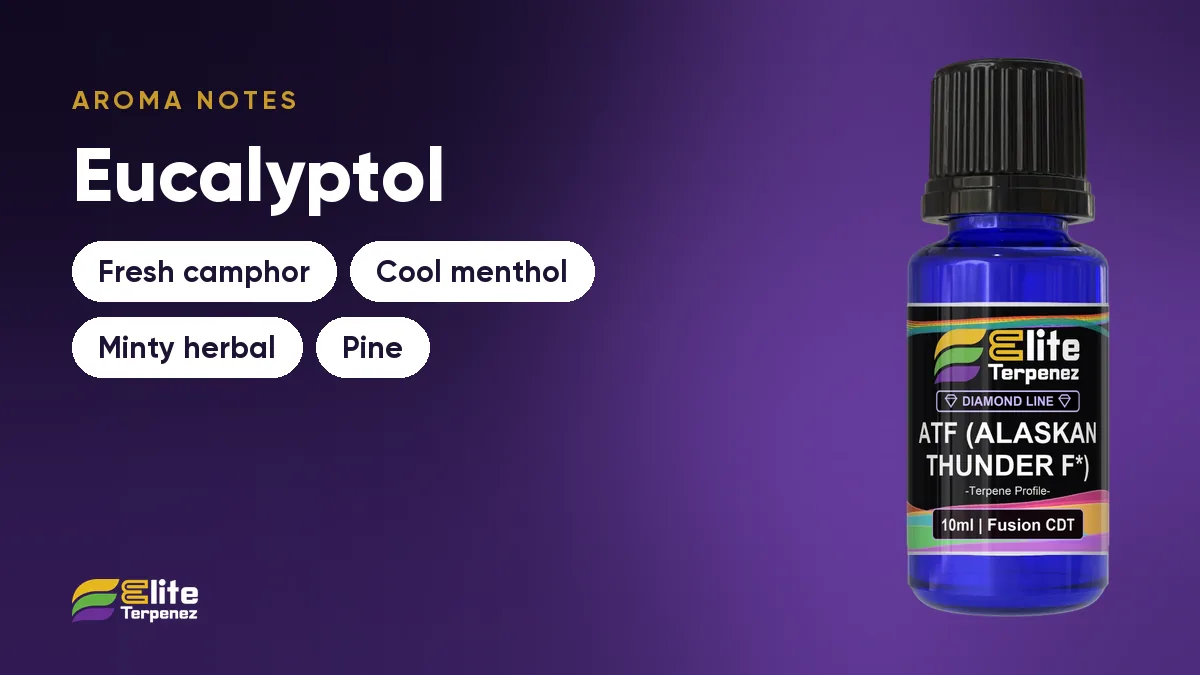
Eucalyptol smells fresh, camphor-like and minty-herbal. PubChem records a camphor-like odour and a spicy, cooling taste. Perfumers also describe a clean, slightly woody freshness, and in flavour work the useful words are simply cool, fresh and herbal.
How a eucalyptol-led aroma reads depends on what sits beside it:
- Alone: a sharp, clean, camphor-and-eucalyptus freshness with a faint woody edge.
- With pine and citrus notes: a crisp forest-and-menthol impression, much like a pine needle crushed in the hand.
- With sweet or creamy notes: a cool-mint dessert character, because a little freshness lifts sugar and cream.
- With sage, herbal or skunky notes: a sharp, green, savoury edge that suits strain-style flavours.
Where is eucalyptol found in nature?
Eucalyptol is the major component of eucalyptus leaf oil. Studies of Eucalyptus globulus leaf oil report 1,8-cineole at anywhere from about 17% to 90% of the total depending on the sample, and one detailed analysis in a peer-reviewed paper on eucalyptus essential oil found 63.1% in the oil it tested. That range is a good reminder that natural amounts vary widely with species, region, leaf age and extraction method.
Outside eucalyptus, eucalyptol is reported in rosemary, bay laurel, sage, camphor laurel and a number of other aromatic plants, where it sits beside pinene, camphor and borneol. It is also reported in the aromatic oils of some cannabis varieties, usually in small amounts, which is one reason menthol-and-pine profiles appear in strain-style flavours.
Plant oils are blends. The smell people call “eucalyptus” is the combination of eucalyptol with pinene, limonene and others, so a single-molecule eucalyptol note smells cooler and sharper than the oil it comes from.
What are the key facts about eucalyptol?
The table below puts eucalyptol next to three related molecules so you can compare the numbers. Data comes from PubChem records for each molecule and boiling points are rounded.
| Molecule | Class | Formula | CAS number | Boiling point | Aroma |
|---|---|---|---|---|---|
| Eucalyptol (1,8-cineole) | Monoterpenoid (cyclic ether) | C10H18O | 470-82-6 | About 176 to 177 C | Fresh, camphor-like, cooling |
| Camphor | Monoterpenoid (ketone) | C10H16O | 76-22-2 | About 204 to 209 C, sublimes | Penetrating, camphor |
| Menthol | Monoterpenoid (alcohol) | C10H20O | 89-78-1 | About 212 to 216 C | Peppermint, cooling |
| Alpha-terpineol | Monoterpenoid (alcohol) | C10H18O | 98-55-5 | About 217 to 221 C | Floral, lilac |
A few more figures help with handling. Eucalyptol has a density of about 0.92 g/mL, so it is lighter than water, and PubChem records a melting point of about 1.5 C. Its water solubility is about 3.5 g/L at 21 C, which is higher than most terpenes, and it mixes freely with ethanol, ether and oils. The closed-cup flash point is about 49 C, close to limonene’s, so treat it as a flammable liquid.

How is eucalyptol different from camphor, menthol and borneol?
Eucalyptol belongs to a family of cool, camphor-and-mint smelling monoterpenoids, and the differences between the members are small but audible. Camphor is a ketone, menthol is an alcohol with a saturated ring, and eucalyptol is an ether. Each carries a different functional group on a similar ten-carbon frame, and the group changes how the molecule smells and behaves.
In smell, menthol is sweet, round and peppermint-like, while eucalyptol is sharper, drier and more camphor-like. Camphor is more penetrating and waxy than either. Borneol, which is a close neighbour on the aroma wheel, smells piney and camphor-like with a woody dryness, and our borneol guide covers it in detail.
The naming is a trap. Cineole is a name used for several related molecules, and 1,8-cineole (eucalyptol, CAS 470-82-6) is the common one, while 1,4-cineole is a different molecule. If a supplier lists “cineole”, check the CAS number before you compare.
How is eucalyptol sourced?
Commercial eucalyptol is mostly obtained by fractional distillation of eucalyptus oil, or from other cineole-rich oils such as rosemary and cajuput, then purified to the specification a buyer needs. Because eucalyptus oil is produced at large scale, it is one of the more widely available natural terpenoids.
In flavour and aroma work, eucalyptol reaches a finished profile in one of three ways:
- Isolated or purified: the single molecule, used as a cool, fresh building block.
- Present in a whole plant extract: eucalyptol alongside the other molecules the plant made, as in cannabis-derived terpenes (CDTs).
- Present in a botanical blend: cooling and herbal notes assembled with other botanical-derived terpenes (BDTs) to recreate a target aroma.
A layered blend usually smells more natural, because the molecules that occur together in a plant balance each other. An isolated eucalyptol note is more predictable but can smell clinical on its own, which is why makers use it as an accent rather than a lead.
Which Elite Terpenez profiles have a cool, minty or herbal aroma?
Elite Terpenez does not sell a single-molecule eucalyptol product. Every profile is a blend, and we do not state the contents of any profile, so the table shows each profile’s listed aroma notes only. Profiles with a cool, menthol, mint or sage aroma such as these sit closest to the eucalyptol direction:
| Profile | Line | Listed aroma notes |
|---|---|---|
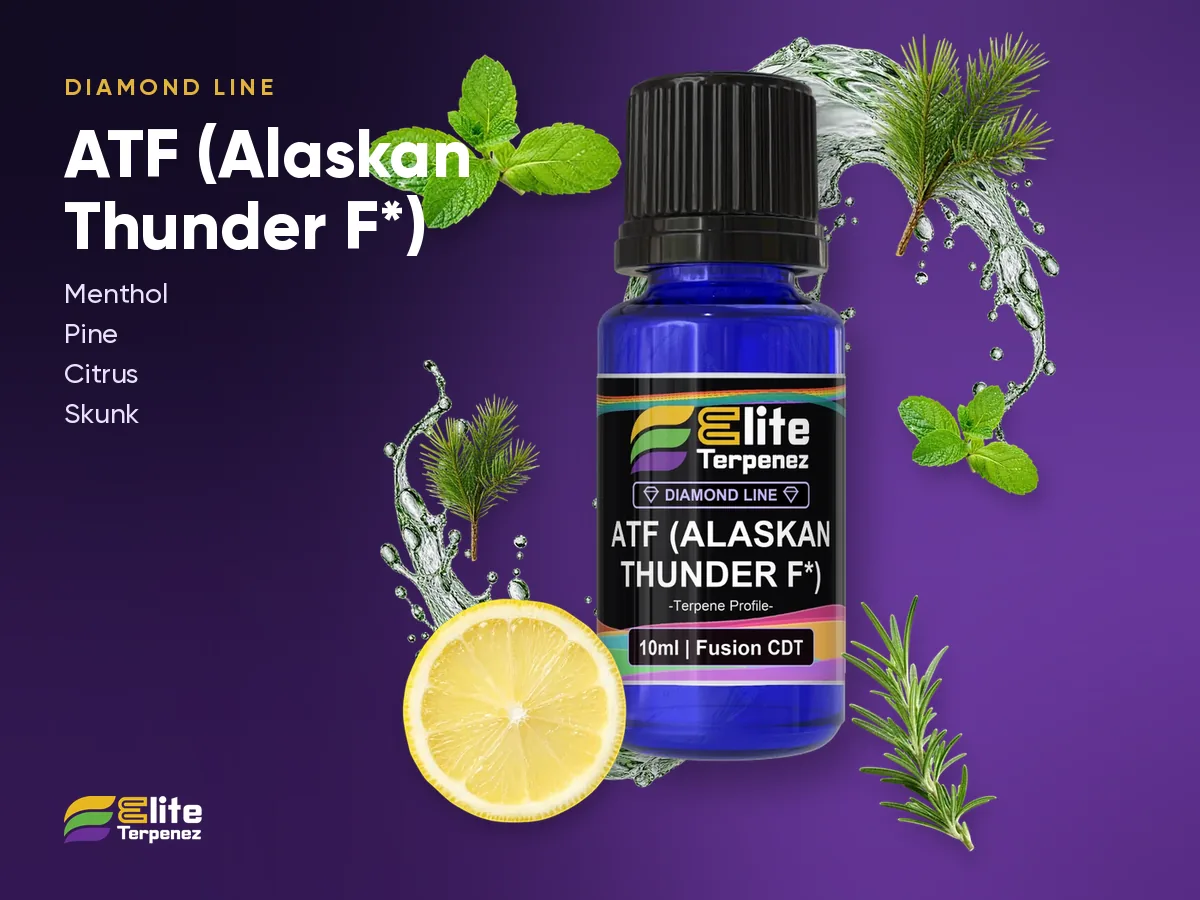
| ATF (Alaskan Thunder F*) | Diamond Line (CDT) | Menthol, pine, citrus, skunk, sage |
| ATF (Alaskan Thunder F*) | Natural Terpenes (BDT) | Menthol and pine, bright citrus, skunk and sage |
| ATF (Alaskan Thunder F*) | Premium Line (CDT) | Fresh pine citrus, earthy undertones, sometimes skunky with hints of mint |
| Kush Mintz DNA | DNA Series (CDT/BDT) | Cool mint, earthy kush, creamy sweetness |
| Spearmint Supreme | Flavour Infused (BDT) | Fresh spearmint, sweet and clean, herbal finish |
| Mojito | Flavour Infused (BDT) | Fresh mint, zesty lime, cane sugar |
For a menthol-and-pine direction with a sage edge, start with ATF, which is sold in three lines so you can compare them. For a sweeter, creamier cool mint, look at Kush Mintz DNA. For a clean mint with no skunk, look at Spearmint Supreme or Mojito. Mint profiles are not eucalyptol, but they sit in the same cool, herbal family on the aroma wheel. To browse more, see the Diamond Line, Natural Terpenes and Premium Line collections, or the full Flavour Catalogue.
For cannabinoid content of any profile other than the Diamond Line, contact us and we will confirm before you order. Diamond Line terpenes contain no THC or other cannabinoids. Cannabis flower is a controlled drug in the UK and Elite Terpenez does not sell cannabis.

What does eucalyptol pair with?
Cool, camphor-like notes work as an accent, and many popular flavours are a fresh, minty lift over something sweet, piney or earthy. Use these pairings as a guide when you plan a blend or choose between profiles:
| Pair cooling notes with | Resulting impression | Example listed aroma notes |
|---|---|---|
| Pine and citrus | Crisp, resinous freshness | ATF Natural Terpenes: menthol and pine, bright citrus, skunk and sage |
| Vanilla and cream | Cool-mint dessert | Kush Mintz DNA: cool mint, earthy kush, creamy sweetness |
| Spearmint and herb | Clean, sweet mint | Spearmint Supreme: fresh spearmint, sweet and clean, herbal finish |
| Lime and sugar | Bright cocktail freshness | Mojito: fresh mint, zesty lime, cane sugar |
These are separate profiles from the Elite range, each with its own listed notes. They show the direction of the pairing and say nothing about what any bottle contains. For the pine side of the aroma wheel, our pinene guide covers the resinous partner that often sits beside eucalyptol in plant oils, and our humulene guide covers the dry, woody base layer.
How do makers use eucalyptol for flavour and aroma?
Makers use cool, camphor-and-mint notes to add freshness and lift to a recipe. They are popular where a sweet, creamy or fruity flavour needs a clean edge, and in strain-style recipes where a sharp, herbal top note is part of the target. They also work well with citrus and pine.
A few practical points:
- Use it as an accent: a little cooling note goes a long way, and too much turns harsh and sharp in a way that reads as a menthol rub rather than a flavour.
- Build, do not stack: pair cool notes with sweet or fruity ones to avoid a flat, single-note result.
- Test small: run a small batch, wait a day, and re-smell it before scaling.
- Expect it to fade first: eucalyptol is more volatile than the sesquiterpenes, so a cooling top note can fade before the base does.
What are the starting cuts and handling rules?
Terpene profiles are concentrated and must never be used undiluted. Elite Terpenez’s starting cuts are 6% for vape cartridges, 4% for concentrates, 2% for tinctures, 1% for edibles, 0.5% for beverages and 3% for topicals. Use the terpene mixing calculator to turn a percentage into a weight, and always test a small batch first.
Eucalyptol has a notable hazard profile. PubChem’s classification lists it as a flammable liquid and vapour and, in most notifications, as a skin sensitiser that may cause an allergic skin reaction. Wear gloves and eye protection, keep every bottle away from children, pets, heat and flames, and work in a ventilated space. For general workplace guidance, see the HSE’s COSHH basics. Products are for adults (18+) only. This guide is about flavour and aroma, and it is not medical advice.
Storage
Store terpene bottles tightly closed in a cool, dark place; refrigerated is ideal. Light, warmth and air speed up oxidation, so a half-empty bottle left open will lose its freshness faster than a full, closed one. Decant what you need and reseal promptly.
If a cool, minty profile starts to smell dull, flat or sharp rather than fresh, it has probably aged. It is better to test a fresh bottle than to adjust your recipe to compensate. Label the date you opened each bottle so you can track how long it has been in use.
Sizes and bulk
Profiles come in 2 ml, 5 ml and 10 ml bottles. For larger runs, ask about bulk on the wholesale and bulk page. Free UK delivery on orders over £80.

Frequently asked questions
What is eucalyptol?
Eucalyptol is a cyclic ether monoterpenoid with the formula C10H18O, also known as 1,8-cineole. It is a colourless liquid with a fresh, camphor-like smell and a CAS number of 470-82-6. It is the main component of eucalyptus leaf oil, and makers use it as a flavour and aroma ingredient.
What does eucalyptol smell like?
Eucalyptol smells fresh, camphor-like and minty-herbal, and PubChem describes its taste as spicy and cooling. It is sharper and drier than the sweet, rounded smell of menthol. In a blended profile it gives a clean, cool top note rather than a base.
Is eucalyptol the same as 1,8-cineole?
Yes. Eucalyptol and 1,8-cineole are two names for the same molecule, CAS 470-82-6. Other names include cineol and cajeputol. Take care with the word cineole alone, because 1,4-cineole is a different molecule. Always compare supplier listings by CAS number.
Where does eucalyptol come from?
Eucalyptol is the major component of eucalyptus leaf oil and is also reported in rosemary, bay laurel, sage and camphor laurel. Commercially it is mostly obtained by distilling eucalyptus oil. Natural amounts vary widely with species, region and extraction method, from under 20% to about 90% in different eucalyptus oil studies.
What is the boiling point of eucalyptol?
Eucalyptol boils at about 176 to 177 C at normal pressure, according to PubChem. Its closed-cup flash point is about 49 C, so it is a flammable liquid and should be kept away from heat and flames. It is more volatile than menthol, which boils at about 212 to 216 C.
Which Elite Terpenez profiles have a cool, minty aroma?
Profiles with a menthol, mint or sage aroma include ATF in the Diamond, Natural Terpenes and Premium lines, Kush Mintz DNA, Spearmint Supreme and Mojito. Each lists its own aroma notes on its product page. Elite Terpenez does not sell a single-molecule eucalyptol product and does not state the contents of its profiles.
Which Elite Terpenez profiles are suggested for eucalyptol, and what are their listed notes?
Start with Diamond Line ATF (Alaskan Thunder F*) (menthol, pine, citrus, skunk, sage); Natural Terpenes ATF (Alaskan Thunder F*) (menthol and pine, bright citrus, skunk and sage); DNA Series Kush Mintz DNA (cool mint, earthy kush, creamy sweetness). Notes come from each product page, and every profile is sold in 2 ml, 5 ml and 10 ml bottles.
Ready to build a cool, fresh flavour? Browse the Diamond, Natural Terpenes and Premium ranges, order samples in 2 ml bottles, or contact us for bulk quantities and to confirm anything about a profile before you order.


