










Key takeaways
- Humulene (alpha-humulene) is a monocyclic sesquiterpene, C15H24, with a molecular weight of 204.35 g/mol and CAS number 6753-98-6.
- It smells woody, earthy and spicy with a dry, hoppy edge, and it is one of the three main components of hop essential oil alongside myrcene and caryophyllene.
- It is a sesquiterpene, so it is heavier and less volatile than monoterpenes such as pinene or limonene, and it lingers longer in a blend.
- Humulene is also called alpha-caryophyllene, but it is not the same molecule as beta-caryophyllene, which is the one most people mean by “caryophyllene”.
- Elite Terpenez sells profiles with woody, herbal and spicy listed aroma notes across several lines. The notes describe the smell, not the contents, and these are blended profiles rather than single-molecule products.
- Never use a concentrated terpene undiluted. Test a small batch first and work from the calculator’s starting cuts.
What is humulene?
Humulene is a colourless, oily liquid made of fifteen carbon atoms. Chemists call it a sesquiterpene, which means it is built from three isoprene units rather than the two found in monoterpenes such as limonene or myrcene. Its formula is C15H24 and its molecular weight is 204.35 g/mol, according to PubChem’s alpha-humulene record.
The molecule is a single large ring of eleven carbon atoms carrying three double bonds and four methyl groups. That shape is unusual: most of the terpenes people meet in flavour work are small, tidy ring systems, while humulene is a flexible, open-looking loop. The name comes from Humulus lupulus, the hop plant, whose cones are rich in it.
You may also see humulene written as alpha-humulene or, in older sources, alpha-caryophyllene. If you are new to the topic, our guide to what terpenes are covers the basics before the detail below.
What does humulene smell like?
Humulene smells woody, earthy and spicy, with a dry, herbal bitterness that people link to hops. It is a quieter, drier smell than the bright citrus of limonene or the fresh pine of pinene. Where those two are top notes that you smell first, humulene sits underneath and gives a blend body and depth.
How a humulene-led aroma reads depends on what sits beside it:
- Alone: dry wood, hop cone and a little dried herb.
- With pine and citrus notes: a resinous, forest-floor impression with a clean lift on top.
- With sweet or dessert notes: a warm, spiced-bakery character, because woody spice gives sugar something to lean on.
- With dark fruit or coffee notes: a deeper, toasted, slightly bitter base.

Where is humulene found in nature?
Humulene is best known from hops, where it is one of the main components of the essential oil. A peer-reviewed study of hop oil biosynthesis states that the major monoterpene and sesquiterpene components of hop essential oils are myrcene, alpha-humulene and beta-caryophyllene. That trio is a large part of what gives hops their characteristic smell.
Outside hops, humulene is reported in the essential oils of several culinary and aromatic plants, including sage, ginger and black pepper, usually alongside caryophyllene. It is also reported in the aromatic oils of many cannabis varieties, which is one reason woody, spicy profiles turn up so often in strain-style flavours. Amounts vary widely with plant variety, region, season and extraction method, so there is no single figure for how much any one plant holds.
Real plant oils are blends. The smell people call “hoppy” or “peppery” is the whole combination of molecules, not humulene alone, which is why a single-molecule humulene note smells woody and dry but not like a full hop or a full peppercorn.
What are the key facts about humulene?
The table below puts humulene next to three related terpenes so you can compare the numbers. Data comes from PubChem records for each molecule and the boiling points are rounded. Humulene’s PubChem boiling point is recorded under vacuum, so it is shown at the pressure it was measured.
| Molecule | Class | Formula | CAS number | Boiling point | Aroma |
|---|---|---|---|---|---|
| Alpha-humulene | Monocyclic sesquiterpene | C15H24 | 6753-98-6 | 99 to 100 C at 3 mmHg | Woody, earthy, spicy, hoppy |
| Beta-caryophyllene | Bicyclic sesquiterpene | C15H24 | 87-44-5 | About 256 to 259 C | Spicy, peppery, woody |
| Myrcene | Acyclic monoterpene | C10H16 | 123-35-3 | About 166 to 167 C | Earthy, musky, herbal |
| Alpha-pinene | Bicyclic monoterpene | C10H16 | 80-56-8 | About 155 to 156 C | Fresh pine |
A few more points help with handling. PubChem records humulene’s melting point as below 25 C, so it is a liquid at room temperature. Like other terpenes it is insoluble in water and mixes with ethanol and oils. The classification notifications on PubChem list skin irritation, eye irritation and respiratory irritation for pure humulene, which is why the handling section below matters.

How is humulene different from caryophyllene?
Humulene and beta-caryophyllene are isomers: both are C15H24 sesquiterpenes made from the same three isoprene units, but the atoms are joined differently. Humulene is a single eleven-membered ring. Caryophyllene is a bicyclic molecule, with a nine-membered ring fused to a small four-membered ring. They are made side by side in plants from the same precursor, farnesyl pyrophosphate, which is why they almost always turn up together.
In smell, caryophyllene is the sharper, more peppery of the two, and humulene is the drier, woodier one. In the lab the two are close enough that they are measured side by side. Our caryophyllene guide covers the peppery partner in detail.
The naming is a trap. Humulene was historically called alpha-caryophyllene, and some supplier listings still use that name. Always check the CAS number: 6753-98-6 is humulene and 87-44-5 is beta-caryophyllene. Using the CAS number removes any doubt when you compare listings.
How is humulene sourced?
Commercial humulene is obtained from plant essential oils, mainly hop oil, or purified from other sesquiterpene-rich oils. Because the molecule is large and the natural amount per plant is modest, it is a less common single-molecule ingredient than limonene or pinene.
In flavour and aroma work, humulene reaches a finished profile in one of three ways:
- Isolated or purified: the single molecule, used as a building block.
- Present in a whole plant extract: humulene alongside the other molecules the plant made, as in cannabis-derived terpenes (CDTs).
- Present in a botanical blend: woody and spicy notes assembled with other botanical-derived terpenes (BDTs) to recreate a target aroma.
A whole-extract or layered blend usually smells more natural, because the molecules that occur together in a plant balance each other. An isolated note is more predictable but flatter. Neither is better in every case; it depends on whether you want a clean woody accent or a complete strain-style aroma.
Which Elite Terpenez profiles have a woody, herbal or spicy aroma?
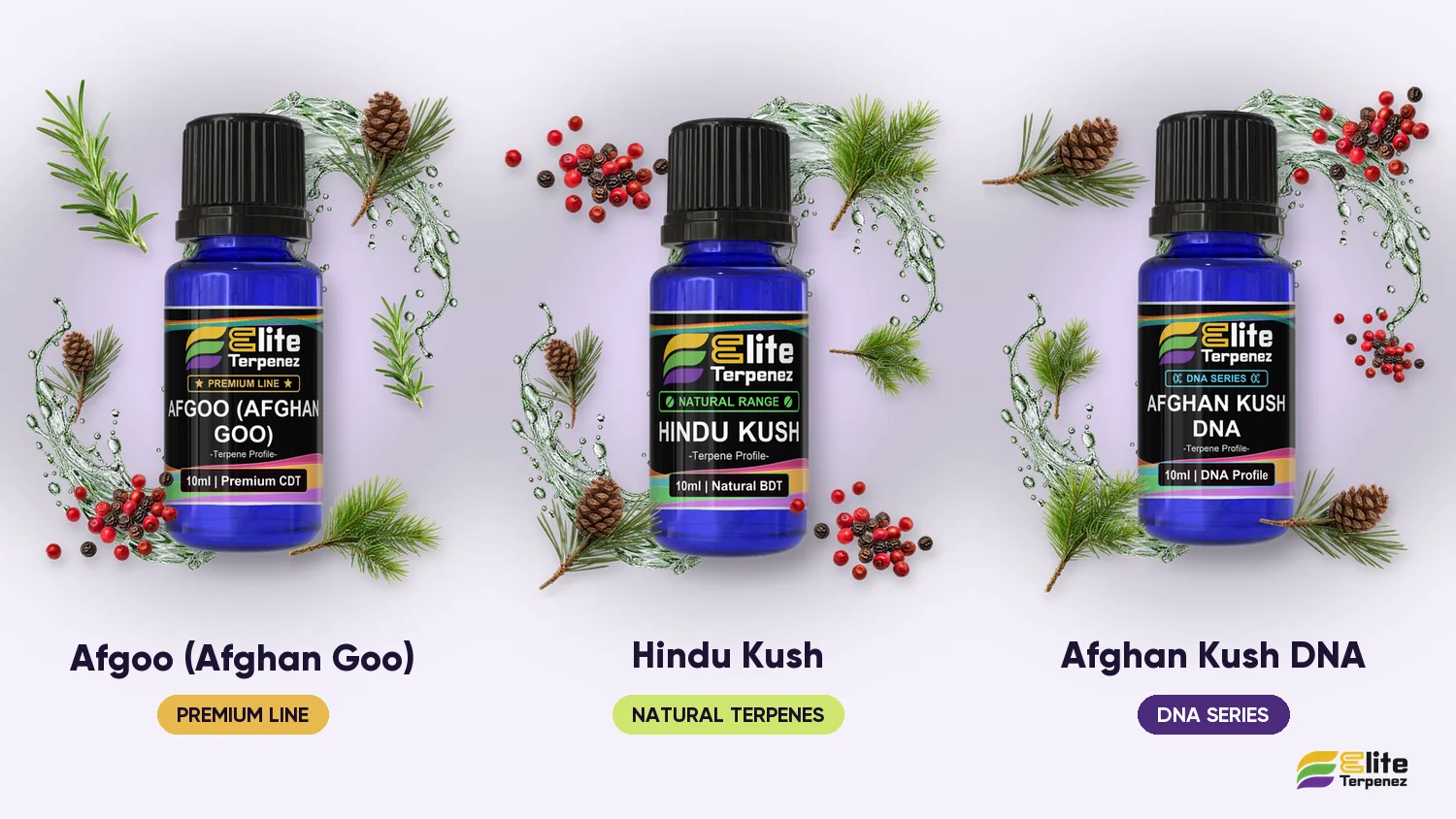
Elite Terpenez does not sell a single-molecule humulene product. Every profile is a blend, and we do not state the contents of any profile, so the table shows each profile’s listed aroma notes only. Profiles with a woody, herbal and spicy aroma such as these are a good place to start:
| Profile | Line | Listed aroma notes |
|---|---|---|
| Afgoo (Afghan Goo) | Premium Line (CDT) | Herbal, woody, spice |
| Hindu Kush | Natural Terpenes (BDT) | Earthy woody spice, sweet pine, faint incense |
| Afghan Kush DNA | DNA Series (CDT/BDT) | Earthy hash, sweet spice, dry wood |
| ACDC | Classic Strains (BDT) | Earthy wood, soft pine, floral spice |
| Bubba Kush | Classic Strains (BDT) | Sweet coffee, dark chocolate, soft wood |
| Grape Ape | All Natural Infused (BDT) | Deep grape, woody spice, soft berry finish |

For a clear herbal-and-woody direction, start with Afgoo. For a drier, incense-tinged wood, look at Hindu Kush or Afghan Kush DNA. For wood with a sweet or fruity top, look at ACDC or Grape Ape, and for a darker, toasted base, Bubba Kush. To browse more, see the Premium Line, Natural Terpenes and DNA Series collections, or the full Flavour Catalogue.
For cannabinoid content of any profile other than the Diamond Line, contact us and we will confirm before you order. Diamond Line terpenes contain no THC or other cannabinoids. Cannabis flower is a controlled drug in the UK and Elite Terpenez does not sell cannabis.
What does humulene pair with?
Woody, hop-like notes work as a base layer, and many popular flavours are a bright or sweet note layered over something dry and earthy. Use these pairings as a guide when you plan a blend or choose between profiles:
| Pair woody notes with | Resulting impression | Example listed aroma notes |
|---|---|---|
| Pine and spice | Dry, resinous forest floor | Hindu Kush: earthy woody spice, sweet pine, faint incense |
| Floral and soft pine | Herbal-floral, tea-like | ACDC: earthy wood, soft pine, floral spice |
| Dark chocolate and coffee | Toasted, bittersweet | Bubba Kush: sweet coffee, dark chocolate, soft wood |
| Grape and berry | Spiced dark fruit | Grape Ape: deep grape, woody spice, soft berry finish |
These are separate profiles from the Elite range, each with its own listed notes. They show the direction of the pairing and say nothing about what any bottle contains. For the fresh top-note side of the aroma wheel, our pinene guide covers pine, and our myrcene guide covers the earthy, herbal partner that sits beside humulene in hop oil.
How do makers use humulene for flavour and aroma?
Makers use woody, hop-like notes to give a product depth and a dry, mature finish. They are popular where a sweet or fruity flavour needs something to stop it tasting flat or sugary, and in strain-style recipes where an earthy, spiced base is part of the target. They also pair easily with citrus and pine.
A few practical points:
- Treat it as a base: humulene-style notes build the floor of a recipe, so add the bright notes on top rather than the other way round.
- Go lightly: a woody, bitter note can overpower a delicate fruit, and too much reads as muddy rather than rich.
- Test small: run a small batch, wait a day, and re-smell it before scaling.
- Expect lingering: sesquiterpenes are less volatile, so a woody note stays after the lighter notes fade, which changes the balance over time.
What are the starting cuts and handling rules?
Terpene profiles are concentrated and must never be used undiluted. Elite Terpenez’s starting cuts are 6% for vape cartridges, 4% for concentrates, 2% for tinctures, 1% for edibles, 0.5% for beverages and 3% for topicals. Use the terpene mixing calculator to turn a percentage into a weight, and always test a small batch first.
Pure humulene is listed on PubChem as a skin, eye and respiratory irritant in many notifications. Wear gloves and eye protection, keep every bottle away from children, pets, heat and flames, and work in a ventilated space. For general workplace guidance, see the HSE’s COSHH basics. Products are for adults (18+) only. This guide is about flavour and aroma, and it is not medical advice.
Storage
Store terpene bottles tightly closed in a cool, dark place; refrigerated is ideal. Light, warmth and air speed up oxidation, so a half-empty bottle left open will lose its freshness faster than a full, closed one. Decant what you need and reseal promptly.
If a woody profile starts to smell flat, sharp or stale rather than dry and warm, it has probably aged. It is better to test a fresh bottle than to adjust your recipe to compensate. Label the date you opened each bottle so you can track how long it has been in use.
Sizes and bulk
Profiles come in 2 ml, 5 ml and 10 ml bottles. For larger runs, ask about bulk on the wholesale and bulk page. Free UK delivery on orders over £80.

Frequently asked questions
What is humulene?
Humulene is a monocyclic sesquiterpene with the formula C15H24, best known as a main component of hop essential oil. It is a colourless oily liquid with a woody, earthy, spicy smell and a CAS number of 6753-98-6. It is also called alpha-humulene. Makers use woody notes like it as a flavour and aroma ingredient.
What does humulene smell like?
Humulene smells woody, earthy and spicy, with a dry, herbal, hop-like bitterness. It is quieter and drier than the bright citrus of limonene or the fresh pine of pinene, and it works as a base note that gives a blend depth. Paired with sweet or fruity notes it adds a warm, spiced finish.
Is humulene the same as caryophyllene?
No. Humulene and beta-caryophyllene are isomers: both are C15H24 but their atoms are joined differently. Caryophyllene (CAS 87-44-5) is a bicyclic molecule with a peppery smell, while humulene (CAS 6753-98-6) is a single eleven-membered ring and smells woodier. Humulene is sometimes called alpha-caryophyllene, which causes confusion.
Where does humulene come from?
Humulene is a main component of hop essential oil, and it is also reported in sage, ginger, black pepper and many cannabis varieties. Commercially it is obtained from plant oils, mainly hop oil. Natural amounts vary with plant variety, region and extraction method, and plant oils are always blends of many molecules.
What is the boiling point of humulene?
PubChem records humulene boiling at 99 to 100 C at a reduced pressure of 3 mmHg. At normal pressure it boils at a much higher temperature, because it is a heavy sesquiterpene. It is therefore less volatile than monoterpenes such as pinene, which boils at about 156 C, and its smell lingers longer in a blend.
Which Elite Terpenez profiles have a woody aroma?
Profiles with a woody, herbal or spicy aroma include Afgoo, Hindu Kush, Afghan Kush DNA, ACDC, Bubba Kush and Grape Ape, across five lines. Each lists its own aroma notes on its product page. Elite Terpenez does not sell a single-molecule humulene product and does not state the contents of its profiles, only their listed aroma notes and ingredients.
Which Elite Terpenez profiles are suggested for humulene, and what are their listed notes?
Start with Premium Line Afgoo (Afghan Goo) (herbal, woody, spice); Natural Terpenes Hindu Kush (earthy woody spice, sweet pine, faint incense); DNA Series Afghan Kush DNA (earthy hash, sweet spice, dry wood). Notes come from each product page, and every profile is sold in 2 ml, 5 ml and 10 ml bottles.
Ready to build a woody, spiced flavour? Browse the Premium, Natural Terpenes and DNA ranges, order samples in 2 ml bottles, or contact us for bulk quantities and to confirm anything about a profile before you order.