










Key takeaways
- Nerolidol is a sesquiterpenoid alcohol, C15H26O, molecular weight 222.37 g/mol, with CAS number 7212-44-4 (40716-66-3 for the trans form).
- Its aroma is soft and woody, like fresh bark, with a faint floral, rose-apple edge. It is a quiet note rather than a loud one.
- At about 275 to 277 C it is far less volatile than citrus terpenes, so it sits in the base of a blend and lingers.
- It occurs in neroli, ginger, jasmine, lavender, tea tree and lemongrass, and Cabreuva oil is a major natural source.
- Elite Terpenez does not sell nerolidol alone. Profiles with a woody, floral aroma are blends, and their listed notes describe the smell, not the contents.
- Never use a concentrated terpene undiluted. Test a small batch first and work from the calculator’s starting cuts.
What is nerolidol?
Nerolidol is a colourless to pale straw-coloured oily liquid made of 15 carbon atoms. Chemists call it a sesquiterpenoid alcohol: it is built from three isoprene units and finished with a hydroxyl (alcohol) group. Its formula is C15H26O and its molecular weight is 222.37 g/mol, according to PubChem’s nerolidol record. The systematic name for the common trans form is (6E)-3,7,11-trimethyldodeca-1,6,10-trien-3-ol.
Nerolidol is also known as peruviol and penetrol. Its name nods to neroli, the orange-blossom oil it is found in. Plants make it from farnesyl diphosphate, the 15-carbon building block behind most sesquiterpenes, which is the same route that gives caryophyllene and bisabolol. The review Biochemistry of Terpenes and Recent Advances in Plant Protection explains how terpene families are built from isoprene units.
It is easiest to picture nerolidol as the larger sibling of linalool. Both are tertiary alcohols with a similar shape, but linalool has 10 carbons and nerolidol has 15. The extra carbons make nerolidol heavier, slower to evaporate and softer in smell.
What does nerolidol smell like?
Nerolidol smells woody, with a faint floral and slightly sweet character. Wikipedia describes the aroma as woody and reminiscent of fresh bark, and PubChem’s physical description gives a faint woody-floral smell with a slightly rose-apple edge. It does not announce itself in the way limonene or pinene do, which is why it is described as a supporting note.
- Alone: soft wood and bark, with a thin floral thread and a hint of green fruit.
- With citrus notes: a woody orange-blossom character, close to neroli itself.
- With floral notes: added depth, so a rose or lavender note smells rounder and less sharp.
- With earthy or spicy notes: a warm, dry woody base that lasts longer than the top notes above it.
Where is nerolidol found in nature?
Nerolidol occurs in the essential oils of many plants and flowers. Wikipedia lists neroli, ginger, jasmine, lavender, tea tree, lemongrass and Cannabis sativa, and notes that it is a dominant scent compound in the orchid Brassavola nodosa. Significant natural sources are Cabreuva oil and the oil of Dalbergia parviflora. The figures vary with plant variety, region and extraction method, so there is no single number for how much any plant holds.
Real essential oils are blends, and the smell people call “neroli” or “jasmine” is the whole oil, not nerolidol alone. A product built on nerolidol alone will smell woody and soft, not like a full flower. That is why makers rarely use it by itself.
What are the key facts about nerolidol?
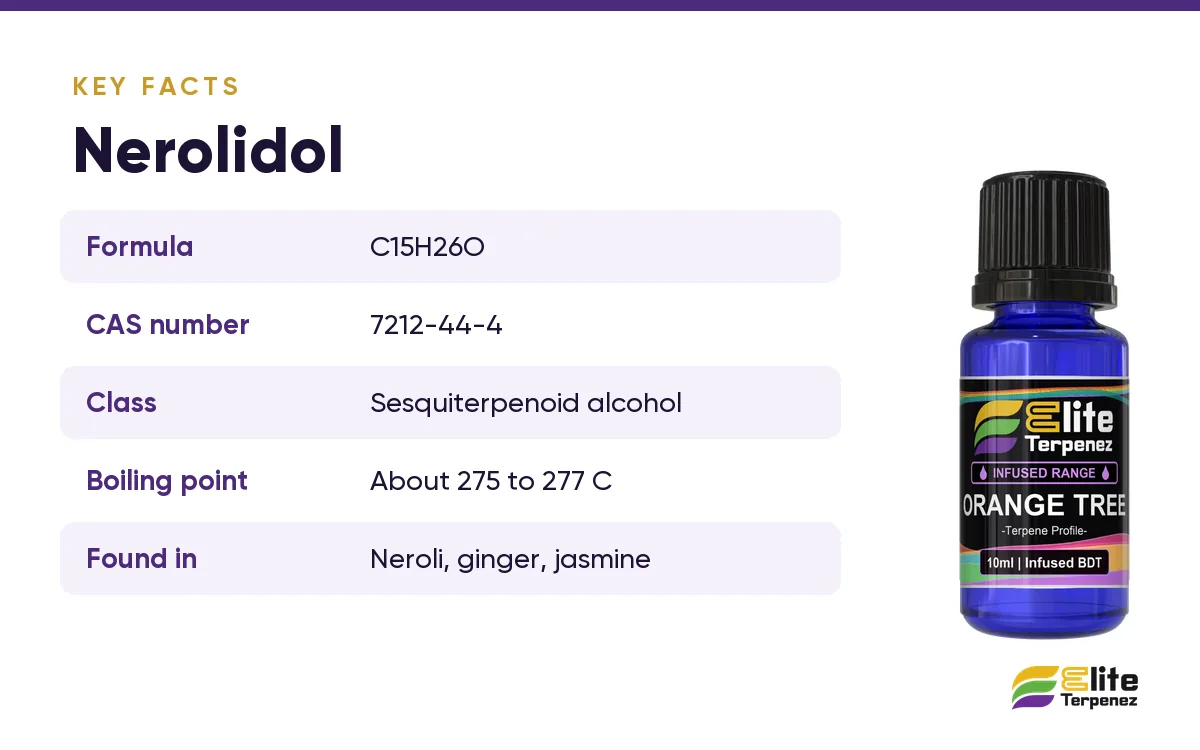
The table below puts nerolidol next to related molecules so you can compare the numbers. Data comes from PubChem records, and boiling points are rounded. Nerolidol has two commonly quoted CAS numbers: 7212-44-4 is the general entry, and 40716-66-3 is given for the trans form, so check which one a supplier’s data sheet uses.
| Molecule | Class | Formula | CAS number | Boiling point | Aroma |
|---|---|---|---|---|---|
| Nerolidol | Sesquiterpenoid (alcohol) | C15H26O | 7212-44-4 | About 275 to 277 C | Woody, bark, faint floral |
| Bisabolol | Sesquiterpenoid (alcohol) | C15H26O | 515-69-5 | About 314 C | Soft floral, honeyed |
| Caryophyllene | Bicyclic sesquiterpene | C15H24 | 87-44-5 | About 256 to 259 C | Pepper, spice |
| Humulene | Monocyclic sesquiterpene | C15H24 | 6753-98-6 | 99 to 100 C at 3 mmHg | Woody, hoppy |
| Linalool | Monoterpenoid (alcohol) | C10H18O | 78-70-6 | About 198 to 200 C | Floral, lavender-like |
Other handling figures help with planning. PubChem gives nerolidol a density of about 0.872 to 0.879 g/ml, so it is lighter than water, and a refractive index of 1.478 to 1.483. It is soluble in ethanol and in most fixed oils and propylene glycol, slightly soluble in water and insoluble in glycerol. That solubility pattern means it mixes into oil, alcohol or glycol bases but needs help in a water-based drink.
How is nerolidol different from linalool, bisabolol and caryophyllene?
Nerolidol sits in a family of related aroma molecules, and the differences are small but audible. Linalool shares its alcohol layout but has 10 carbons, so it smells lighter and more lavender-like. Bisabolol is another 15-carbon alcohol, with a softer, honeyed floral smell and a higher boiling point. Caryophyllene is a 15-carbon hydrocarbon with no alcohol group, so its smell is peppery and spicy, not floral.
One useful link: nerolidol can be converted to farnesol, a related 15-carbon alcohol, and the two are close cousins in perfumery. Because of the shared family, a profile that leans on woody and floral notes will often sit alongside several of these molecules. Our guides to humulene and terpineol cover two more woody and floral neighbours.
How is nerolidol sourced?
Commercial nerolidol is made from geranylacetone, a starting material from the fragrance industry, or isolated from natural oils such as Cabreuva oil. It is a standard flavour and fragrance ingredient, and PubChem lists it among the flavouring substances recognised in the EU. In both cases the product is refined to the specification a buyer needs.
In flavour and aroma work, nerolidol reaches a finished profile in one of three ways:
- Isolated or purified: the single molecule, used as a building block in a blend.
- Present in a whole plant extract: nerolidol alongside the other molecules the plant made, as in cannabis-derived terpenes (CDTs).
- Present in a botanical blend: nerolidol combined with other botanical-derived terpenes (BDTs) to recreate a target aroma.
A layered profile usually smells more natural, while an isolated note is more predictable. The Wikipedia entry on nerolidol gives a short overview of its isomers and its uses in perfumery and flavouring. It notes that there are four isomers, which differ in the geometry around the central double bond and the arrangement at the carbon carrying the hydroxyl group, and that most applications use a mixture of them.
Which Elite Terpenez profiles have a woody, floral aroma?
Elite Terpenez does not sell nerolidol on its own. Our profiles are blends, and we never state a profile’s contents or percentages. What we can do is show profiles whose listed aroma notes sit in the same woody, floral and citrus-blossom territory, so you can sample a direction rather than a single molecule. The notes below come straight from each product page.
| Profile | Line | Listed aroma notes |
|---|---|---|
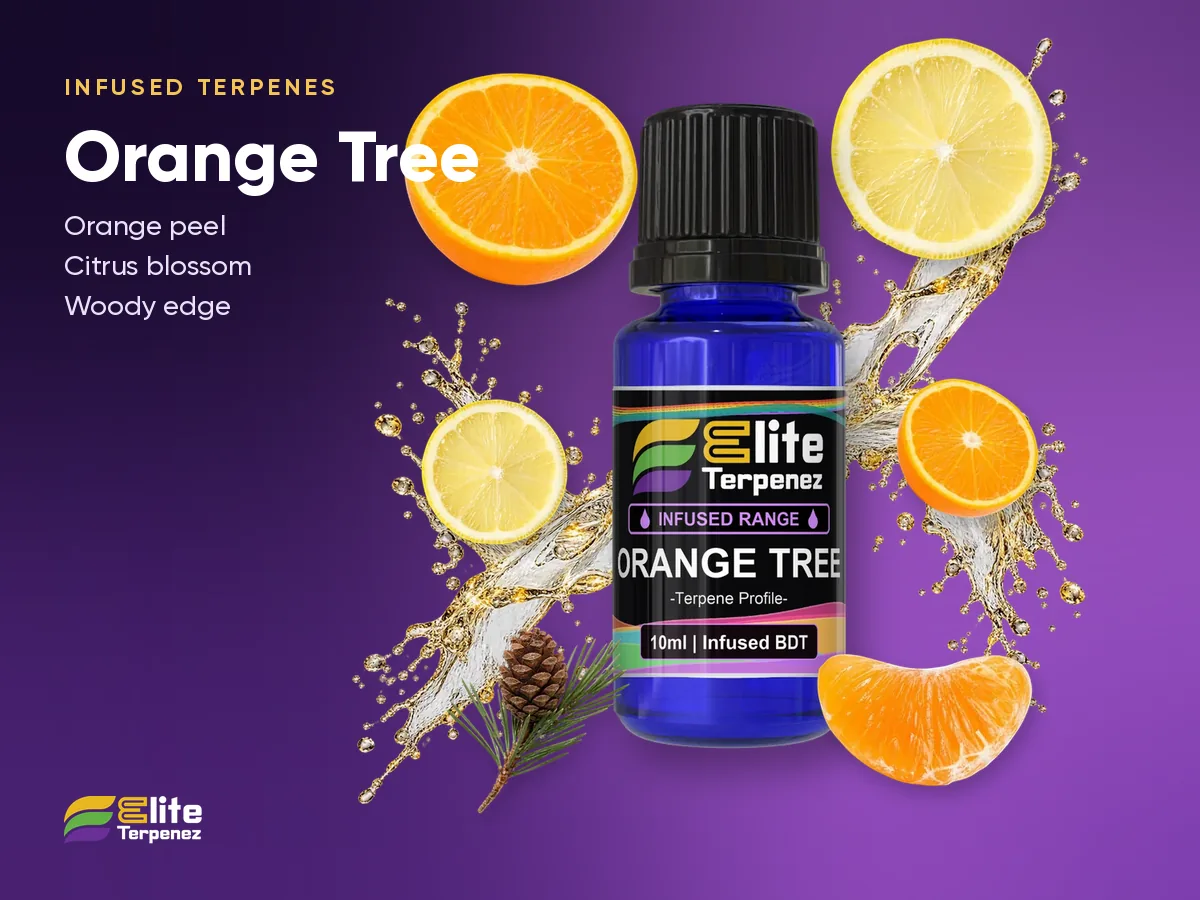
| Orange Tree | Infused Terpenes (BDT) | Orange peel, citrus blossom, woody edge |
| Super Silver Haze | Classic Strains (BDT) | Earthy spice, sweet citrus, woody floral |
| White Widow | Classic Strains (BDT) | Earthy wood, sweet pine, soft floral |
| Trainwreck | Premium Line (CDT) | Earthy, floral, pine |
| Hindu Kush | Natural Terpenes (BDT) | Earthy woody spice, sweet pine, faint incense |
| Thai Stick DNA | DNA Series (CDT and BDT) | Bright citrus, sweet spice, woody herb |
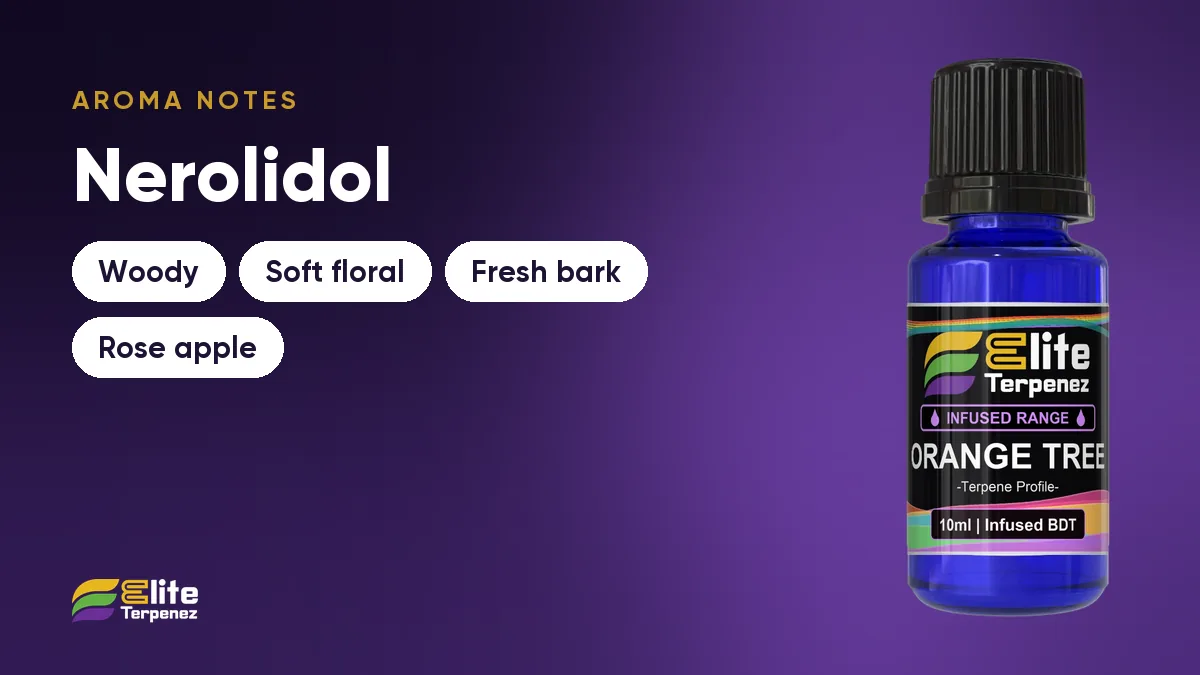
For a clear citrus-blossom direction with a woody base, start with Orange Tree. For a floral and woody strain-style note, look at Super Silver Haze or White Widow, and for a cannabis-derived option with a floral, earthy character, look at Trainwreck. To browse more, see the Infused Terpenes, Classic Strains, Premium Line and Natural Terpenes collections, or the full Flavour Catalogue.
For cannabinoid content of any profile other than the Diamond Line, contact us and we will confirm before you order. Diamond Line terpenes contain no THC or other cannabinoids.

What does nerolidol pair with?
Nerolidol is a team player, and the pairings below show how a woody, floral base supports other notes. Use them as a guide when you plan a blend or choose between profiles.
| Pair a woody-floral note with | Resulting impression | Example listed aroma notes |
|---|---|---|
| Sweet citrus | Orange blossom, neroli-like | Orange Tree: orange peel, citrus blossom, woody edge |
| Pine and earth | Warm forest floor | Hindu Kush: earthy woody spice, sweet pine, faint incense |
| Soft floral | Rounded, perfumed wood | White Widow: earthy wood, sweet pine, soft floral |
| Herb and spice | Dry, aromatic and woody | Thai Stick DNA: bright citrus, sweet spice, woody herb |
These are separate profiles from the Elite range, each with its own listed notes. They show the direction of a pairing and say nothing about what any bottle contains. For a brighter counterpoint, our limonene guide covers the citrus side, and our pinene guide covers pine.
How do makers use nerolidol for flavour and aroma?
Makers use woody and floral profiles to add depth and a lingering base to a blend. A base note that does not evaporate quickly keeps the finished smell steady while the light citrus on top fades, which helps a product smell the same from first opening to last. Floral-woody directions also read as natural and a little refined, so they suit premium-feeling products.
- Use it as support: a quiet note works best underneath a lead flavour, not as the lead.
- Build, do not stack: pair it with citrus, fruit or cream to avoid a flat, single-note result.
- Test small: run a small batch, wait a day, and re-smell it before scaling.
- Mind the base: it dissolves in oils, alcohol and glycol, but not in water, so a drink needs a suitable emulsifier or solubiliser.
What are the starting cuts and handling rules?
Terpene profiles are concentrated and must never be used undiluted. Elite Terpenez’s starting cuts are 6% for vape cartridges, 4% for concentrates, 3% for topicals, 2% for tinctures, 1% for edibles and 0.5% for beverages. Use the terpene mixing calculator to turn a percentage into a weight, and always test a small batch first.
PubChem’s aggregated notifications for nerolidol list serious eye irritation in most reports, skin irritation or skin sensitisation in a smaller share, and a classification as very toxic to aquatic life, with a long-term hazard, in most. So wear gloves and eye protection, work in a ventilated space, keep it away from children, pets, heat and flames, and keep it out of drains. For general workplace guidance, see the HSE’s COSHH basics. Products are for adults (18+) only.
Storage
Store terpene bottles tightly closed in a cool, dark place; refrigerated is ideal. Light, warmth and air speed up oxidation, so a half-empty bottle left open will lose its freshness faster than a full, closed one. Decant what you need and reseal promptly. If a woody profile starts to smell flat, sharp or stale, it has probably aged, and it is better to test a fresh bottle than to adjust your recipe to compensate. Label the date you opened each bottle.
Sizes and bulk
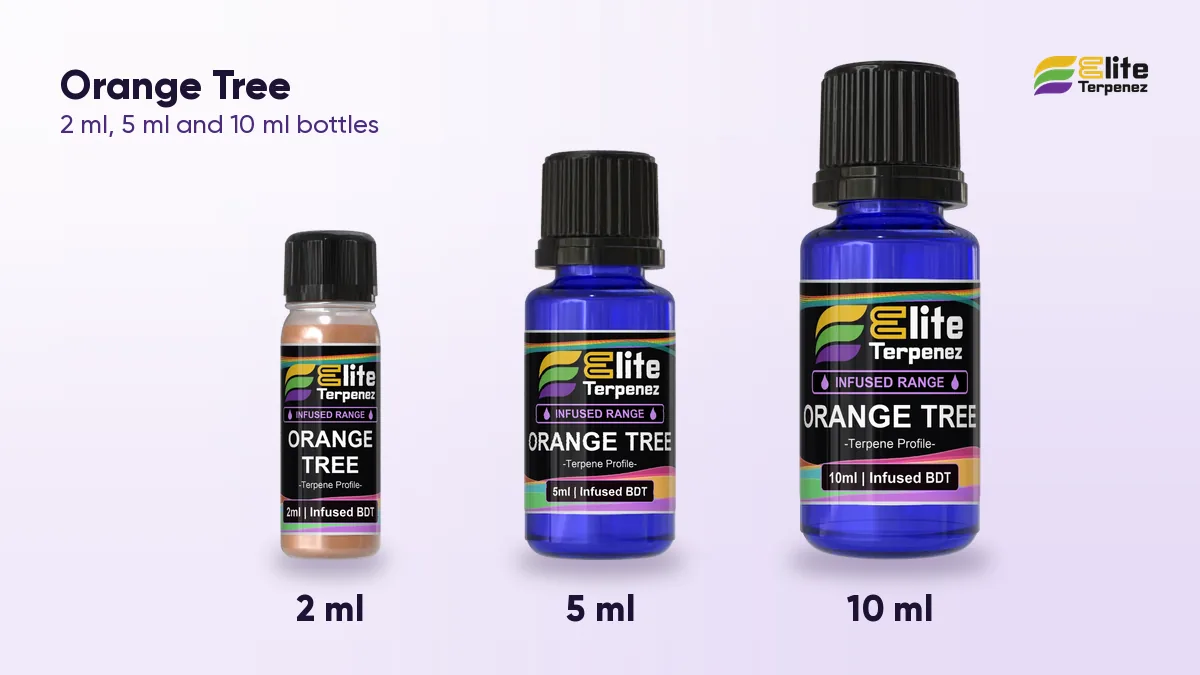
Profiles come in 2 ml, 5 ml and 10 ml bottles. For larger runs, ask about bulk on the wholesale and bulk page. Free UK delivery on orders over £80. To understand the wider range, read our What Are Terpenes? guide.
Frequently asked questions
What is nerolidol?
Nerolidol is a sesquiterpenoid alcohol with the formula C15H26O, found in neroli, ginger, jasmine, lavender and tea tree. It is a colourless to pale straw oily liquid with a woody, faintly floral smell, a CAS number of 7212-44-4 and a boiling point of about 275 to 277 C. Makers use it as a flavour and aroma ingredient.
What does nerolidol smell like?
Nerolidol smells woody, like fresh bark, with a faint floral and slightly rose-apple edge. It is softer and quieter than the sharp citrus of limonene or the fresh pine of pinene, so in a blend it works as a supporting base note that lingers after lighter notes fade.
Where does nerolidol come from?
Nerolidol is found in neroli, ginger, jasmine, lavender, tea tree, lemongrass and many other plants, and Cabreuva oil is a major natural source. Commercially it is also made from geranylacetone. Natural amounts vary with plant variety, region and extraction method, so there is no single figure for how much any plant holds.
What is the difference between nerolidol and linalool?
Both are alcohols with a similar shape, but linalool has 10 carbons (C10H18O) and nerolidol has 15 (C15H26O). Linalool is lighter, floral and lavender-like, and boils near 198 C. Nerolidol is heavier, woody and quieter, and boils near 275 C. Their CAS numbers are 78-70-6 and 7212-44-4.
Is nerolidol the same as bisabolol?
No. Both are 15-carbon alcohols with the formula C15H26O, but their atoms are arranged differently. Nerolidol smells woody and bark-like, and boils at about 275 to 277 C. Bisabolol smells soft, floral and honeyed, and boils at about 314 C. Their CAS numbers differ too: 7212-44-4 and 515-69-5.
Which Elite Terpenez profiles have a woody, floral aroma?
Profiles with a woody, floral or citrus-blossom aroma include Orange Tree, Super Silver Haze, White Widow, Trainwreck, Hindu Kush and Thai Stick DNA, across five lines. They are blends, and each lists its own aroma notes on its product page. Elite Terpenez does not state what any profile contains.
Which Elite Terpenez profiles are suggested for nerolidol, and what are their listed notes?
Start with Infused Terpenes Orange Tree (orange peel, citrus blossom, woody edge); Classic Strains White Widow (earthy wood, sweet pine, soft floral); Premium Line Trainwreck (earthy, floral, pine). Notes come from each product page, and every profile is sold in 2 ml, 5 ml and 10 ml bottles.
Ready to build a woody, floral flavour? Browse the Infused, Classic Strains and Premium ranges, order samples in 2 ml bottles, or contact us for bulk quantities and to confirm anything about a profile before you order.