











Key takeaways
- Terpene profiles are concentrated flavour and aroma ingredients. They are always diluted, measured by weight and tested in a small batch before you scale.
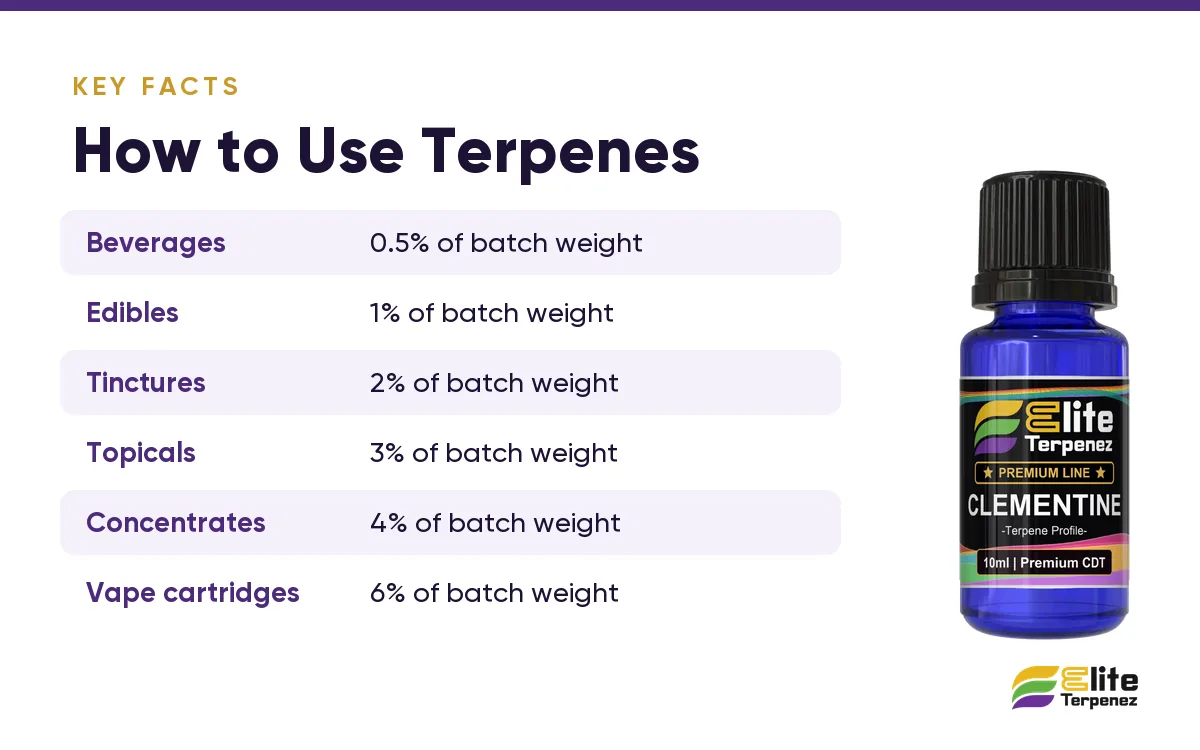
- Starting cuts, as a percentage of total batch weight: vape cartridges 6%, concentrates 4%, topicals 3%, tinctures 2%, edibles 1%, beverages 0.5%.
- The core sum is simple: terpene weight = batch weight x percentage. If you add terpene to a base instead of weighing to a final total, the true percentage comes out slightly lower.
- Add terpenes last, at the lowest workable temperature, and mix gently. Light top notes such as limonene and pinene evaporate first.
- A single 2 ml bottle is enough for several test batches, which is why a 2 ml test comes before any 5 ml, 10 ml or bulk order.
- Store bottles tightly closed, cool and dark, wear gloves and eye protection, and keep everything away from children, pets, heat and flames. Adults (18+) only.
What does it mean to use terpenes properly?
Using terpenes properly means treating a profile as a concentrate that carries a very large amount of smell and taste in a very small volume. A fraction of a gram can flavour a whole batch, so the skill is not in adding terpene but in measuring it, spreading it evenly and judging the result fairly. If you want the background on what terpenes are, start with our What Are Terpenes? guide, and come back here for the practical part.
This guide is for adult product makers, brands and manufacturers in the UK. It covers starting percentages, dilution sums with worked examples, mixing order, test batches, tools, storage and common mistakes. Everything here concerns flavour and aroma: Elite Terpenez sells terpenes as flavour and aroma ingredients, and the rules for your own finished product are yours to check.
Five habits sit behind every good result: weigh rather than guess, start low, add last, test small and write it down.
Before you start: safety and workspace
Concentrated terpenes need the same respect as any other flavour or fragrance concentrate. Many are skin irritants or skin sensitisers, and several are flammable liquids. PubChem lists limonene, for example, with a closed-cup flash point of 45 C, which is low enough that a warm room, a hot plate or a naked flame matters. The HSE explains the basics of fire and explosion risks at work. Read the details for the profile you buy, and see our quality and safety page.
| Area | What to do | Why |
|---|---|---|
| Skin and eyes | Wear nitrile gloves and eye protection every time you open a bottle | Concentrated terpenes can irritate skin and eyes, and some are sensitisers |
| Air | Work in a ventilated room and avoid breathing vapour | Volatile molecules collect above the bottle and the mixing vessel |
| Heat and flame | Keep heat sources, sparks and naked flames away from open bottles | Many terpenes have low flash points |
| Containers | Use glass or other vessels that suit concentrated terpenes | Some plastics absorb terpenes or react with them |
| People and pets | Store and work where children and pets cannot reach | Concentrates are not for casual handling |
For general workplace principles on hazardous substances, the HSE’s COSHH basics and its page on personal protective equipment are good starting points. Products are for adults (18+) only.
What percentage of terpenes should you use?
Terpene percentage is the weight of terpene as a share of the total weight of the finished batch. A 2% cut means 2 g of terpene in every 100 g of finished product. There is no single right figure, because the right cut depends on the base, how the product is used, how loud the profile is and what you personally want to smell and taste. That is why we give starting cuts and not rules.
| Product type | Starting cut | Terpene in a 100 g batch | Terpene in a 1 kg batch |
|---|---|---|---|
| Vape cartridges | 6% | 6 g | 60 g |
| Concentrates | 4% | 4 g | 40 g |
| Topicals | 3% | 3 g | 30 g |
| Tinctures | 2% | 2 g | 20 g |
| Edibles | 1% | 1 g | 10 g |
| Beverages | 0.5% | 0.5 g | 5 g |
These are the same starting cuts used by our terpene mixing calculator. They are starting points for adults making products within the law. Your base, recipe and local rules all affect what works, so always test a small batch first.
Why do the cuts differ by product type?
The spread from 0.5% to 6% reflects how different products carry and release flavour. A thin, water-based drink spreads a little flavour across a lot of volume and is easily overpowered, so the cut is the lowest. A product with a heavy, oily or waxy base can hold much more terpene before the smell turns harsh or the texture changes, so the cut is higher.
- Carrier: oils, glycols, alcohols and waxes dissolve terpenes to different degrees, and water does not dissolve them at all.
- Volatility: light terpenes escape quickly, so products that are heated or opened often need a different balance from sealed ones.
- Intensity of the profile: a bold dessert profile may need a lower cut than a soft floral one to read as balanced.
Start at or below the starting cut, adjust in small steps, and change one variable per test so you know what caused the difference. Then fix the number in a written recipe.

How does terpene dilution work?
Terpene dilution is a weight calculation. Weigh the batch you want, multiply by the percentage and you have the terpene weight. Use a scale that reads to 0.01 g and measure by weight, not by drops or by volume, because terpene density varies between profiles and bottles dispense unevenly.
The formula is one line:
Terpene weight (g) = final batch weight (g) x percentage / 100
Base weight (g) = final batch weight (g) – terpene weight (g)
Always decide the cut on the final batch. Adding terpene to a fixed base weight gives a slightly lower percentage than the number you were aiming for, and the error grows with the cut. The table shows the difference.
| Aim | If you add that weight to 100 g of base | True percentage in the finished batch |
|---|---|---|
| 0.5% | 0.5 g | 0.50% |
| 2% | 2 g | 1.96% |
| 4% | 4 g | 3.85% |
| 6% | 6 g | 5.66% |
At a 0.5% cut the gap is too small to notice, while at 6% it is more than a third of a percentage point. For a repeatable recipe, always weigh the base as the final weight minus the terpene weight.
Worked example 1: a 100 g batch at 2%
You want 100 g of a tincture-style product at the 2% starting cut. Terpene = 100 x 2 / 100 = 2.00 g. Base = 100 – 2.00 = 98.00 g. Weigh 98.00 g of base into the vessel, add 2.00 g of terpene profile, and the batch is 2.00% by weight.
Worked example 2: a 350 g beverage batch at 0.5%
You want 350 g of a beverage concentrate at the 0.5% starting cut. Terpene = 350 x 0.5 / 100 = 1.75 g. Base = 350 – 1.75 = 348.25 g. This is a small weight, so use a scale that reads to 0.01 g and weigh in stages.
Worked example 3: a blend of three profiles
You want 250 g of an edible-style product at 1%, using three profiles in a 70 : 20 : 10 weight ratio. Total terpene = 250 x 1 / 100 = 2.50 g. Split that by the ratio: 70% is 1.75 g, 20% is 0.50 g and 10% is 0.25 g. Base = 250 – 2.50 = 247.50 g. The total cut is still 1%, and each profile is a share of that cut, not an extra cut of its own.
Worked example 4: working backwards from what you added
You added 0.35 g of terpene to 20.00 g of base. The finished batch weighs 20.35 g, so the cut is 0.35 / 20.35 x 100 = 1.72%. Always divide by the finished weight, not the base weight.
Worked example 5: how many batches does a bottle make?
Terpene profiles are usually a little lighter than water. Planning with a density of about 0.87 g/ml is reasonable (PubChem lists 0.842 g/ml for limonene and about 0.87 to 0.88 g/ml for nerolidol), but profiles differ, so weigh your own bottle before and after if you need precision. At that density a 2 ml bottle holds about 1.74 g, a 5 ml bottle about 4.35 g and a 10 ml bottle about 8.7 g.
| Cut | 2 ml bottle (about 1.74 g) makes | 5 ml bottle (about 4.35 g) makes | 10 ml bottle (about 8.7 g) makes |
|---|---|---|---|
| 0.5% (beverages) | about 348 g | about 870 g | about 1,740 g |
| 1% (edibles) | about 174 g | about 435 g | about 870 g |
| 2% (tinctures) | about 87 g | about 218 g | about 435 g |
| 3% (topicals) | about 58 g | about 145 g | about 290 g |
| 4% (concentrates) | about 44 g | about 109 g | about 218 g |
| 6% (vape cartridges) | about 29 g | about 73 g | about 145 g |
The terpene mixing calculator does this arithmetic for you and shows a sensible mix of 2 ml, 5 ml and 10 ml bottles for your batch size, pointing you to bulk when the batch is large. We explained the update in our calculator bottle-mix news post, and the bottles themselves in our 2 ml, 5 ml and 10 ml sizes post.
Worked example 6: using a stock solution for very small weights
A 0.5% cut in a 20 g test batch is only 0.10 g of terpene, and a scale that reads to 0.01 g is out by up to 10% of that. A stock solution fixes the problem. Make a 10% stock by weighing 1.00 g of terpene into 9.00 g of a compatible carrier, mixing well, then add 1.00 g of stock for every 0.10 g of terpene you need. For the 20 g batch, 1.00 g of stock gives 0.10 g of terpene, and the same scale error is now 1% of what you are weighing. Check that the carrier suits your base and your rules, and label the stock with the date and percentage.
What order should you mix in?
Mix in an order that protects the delicate top notes and spreads the terpene evenly. The order below works for most bases, and the main idea is to add terpene last and to apply as little heat as the base allows.
- Prepare. Put on gloves and eye protection, clear the bench of flames and heat sources, and set out clean glass vessels, a scale and your recipe sheet.
- Weigh the base. Place the vessel on the scale, tare it, then weigh the base to the figure from your calculation.
- Bring the base to a workable state. If the base is thick or solid, warm it gently until it will mix. Do not go hotter than you need to, and let it cool to a comfortable working temperature before the next step if you can.
- Tare again and add the terpene. Weigh the terpene into the base. If you are blending profiles, add the heaviest, base-note profile first and the light, top-note profile last.
- Mix gently and thoroughly. Stir or swirl until the batch looks and smells uniform. Vigorous whipping adds air, which carries off volatile notes and speeds up oxidation.
- Cover and rest. Seal the vessel and leave it for a day. Smell and taste change as the mix settles.
- Judge, adjust and record. Compare the batch with your notes, change one variable at a time, and write down what you did.
Why do you add terpenes last?
Terpenes are volatile, and the lighter ones leave a warm batch quickly. The table shows approximate boiling points for terpenes you may meet, taken from the PubChem records and our terpene guides. A lower boiling point means a more volatile molecule and a brighter, faster-moving top note.
| Terpene | Approximate boiling point | Aroma | Volatility |
|---|---|---|---|
| Pinene | About 156 to 165 C | Fresh pine | Very volatile, top note |
| Myrcene | About 166 to 167 C | Herbal, ripe fruit | Volatile, top to middle |
| Limonene | About 175 to 178 C | Citrus peel | Volatile, top note |
| Terpinolene | About 183 to 187 C | Fresh, piney, floral | Middle |
| Linalool | About 198 to 200 C | Floral, lavender-like | Middle |
| Caryophyllene | About 256 to 259 C | Pepper, spice | Base note |
| Bisabolol | About 314 C | Soft, floral, honeyed | Base note |
None of these molecules boils at room temperature, but evaporation happens well below the boiling point, and it speeds up with warmth, airflow and surface area. A wide, open, warm vessel loses the top notes faster than a narrow, closed, cool one. So add terpene late, and cover the vessel while it rests.
How do you run a small test batch?
A test batch is a deliberately small version of your recipe, made to find out whether the flavour works before you commit a larger volume of base or terpene. Make it about a tenth the size of your normal batch, or 20 g to 50 g, whichever is smaller, and treat it like the real thing.
- Choose one profile and one base, and write both on the record sheet.
- Calculate the batch at the starting cut for your product type.
- Make the batch exactly as the real one would be made, in the same order and at the same temperature.
- Smell and taste a small sample straight away and record your first impression in plain words.
- Cover the batch, store it as you would the real thing, and judge it again after a day and after a week.
- Change one variable, such as the cut, and make a second test batch. Compare the two side by side.
Keep a simple record for every test so a good result can be repeated exactly:
| Field | Example entry | Why it matters |
|---|---|---|
| Date and batch label | 28 Nov, test 3 | Lets you compare tests in order |
| Profile and SKU | Orange Tree, ET-INF-087 | Profiles with similar names differ between lines |
| Base and weight | Base X, 49.00 g | The base changes how terpenes behave |
| Terpene weight and percentage | 1.00 g, 2.0% | The number you will scale from |
| Temperature and mixing time | Cooled to 30 C, 3 minutes | Heat and time change how much top note survives |
| Notes at day 0, 1 and 7 | Bright, then rounder, faint bitterness at day 7 | Shows how the mix settles and ages |
| Decision | Drop to 1.5% and retest | Turns a note into an action |
What is the 2 ml test?
The 2 ml test is our name for buying the smallest bottle first. Every Elite Terpenez profile comes in 2 ml, 5 ml and 10 ml, and at about 1.74 g a 2 ml bottle gives you around four 20 g test batches at 2%, or around ten at 0.5%. That is enough to learn how a profile behaves in your base before you spend on a larger bottle. When a profile works, reorder it in a bigger size, and when your volumes increase ask about bulk on our wholesale and bulk page.

How do you mix several terpene profiles together?
Blending profiles is where most of the craft lies, and the same weight sums apply. Pick a lead profile that sets the overall direction, then add a smaller accent that supports it. A common maker’s rule of thumb is roughly 60 to 80% of the terpene weight in the lead, 15 to 30% in the accent and no more than 10% in a finishing note. This is a starting idea, not a recipe, and your ear decides the final balance.
| Goal | Lead profile (listed notes) | Accent (listed notes) | Why the pair works |
|---|---|---|---|
| A bright citrus drink | Orange Tree (orange peel, citrus blossom, woody edge) | Clementine (citrus, sweet, fresh) | Two citrus directions, one with a woody base and one fresh |
| A cream and cookie dessert | Wedding Cake Flavour Infused (vanilla sponge, buttercream frosting, soft creamy finish) | Biscotti Classic Flavour Infused (toasted biscuit, sweet cream, gentle spice) | Both are creamy and baked, with a little spice in the second |
| A candy and berry flavour | Blue Zkittles (blue raspberry candy, sweet berry, tangy sugar finish) | Orange Tree (as above) | A touch of citrus lifts a sweet candy note |
These pairings describe listed aroma notes only. Elite Terpenez does not state what is in any profile or in what proportion, so treat each pairing as an idea to test, not a promise. For more on how a profile is built from named aroma notes, see our guides to limonene, linalool and humulene.

Why will terpenes not mix into some bases?
Terpenes are oily molecules and dissolve according to the rule that like mixes with like. PubChem lists limonene’s solubility in water at only about 7.6 mg per litre at 25 C, while it is miscible with alcohol. A watery base with no help will leave terpene floating on top, cloudy or separated, and that is a mixing problem, not a terpene fault.
| Base type | How terpenes behave | What to do |
|---|---|---|
| Oils and fats | Mix readily | Stir gently at a moderate temperature |
| Alcohol | Dissolves well in most cases | Keep the vessel covered, as alcohol and terpenes both evaporate |
| Glycols and glycerol-based bases | Dissolve to different degrees depending on the base and the terpene | Mix thoroughly and check for cloudiness after a day |
| Water-based drinks | Do not dissolve and separate | Use a suitable emulsifier or solubiliser and test the blend |
| Waxes and solid bases | Mix only once the base is soft or liquid | Warm gently, add terpene last and stir as it cools |
Whether a profile suits a given base, and whether a particular emulsifier or carrier is suitable for your product and under the rules that apply to it, are things only you can confirm. Our listed ingredients show whether a profile is cannabis-derived (CDT) or botanical-derived (BDT) and whether flavouring is listed. If you want help matching a profile to a base, contact us before you order.
How do you judge a test batch?
Judge a batch the same way every time. Smell the vessel, then a sample on a clean surface, then taste or apply a small amount if that is how the product is normally used. Compare against a control made with the same base but no terpene, so you know what the terpene adds, and write down words, not just scores.
| Problem | Likely cause | Try this |
|---|---|---|
| Smell is harsh or soapy | The cut is too heavy for the base | Drop the cut by a quarter and retest |
| Smell is flat or faint | Cut too low, top notes lost to heat or air, or an old bottle | Raise the cut slightly, add terpene later and cooler, or test fresh stock |
| Flavour is bitter | Overuse, or a base that clashes with the profile | Reduce the cut and try a profile with a softer, sweeter lead |
| Cloudy or separated batch | Terpene did not dissolve in the base | Change the carrier, add an emulsifier, or mix longer at a gentle warmth |
| Smell changes after a day | Light notes settled or evaporated | Judge on day 1 and day 7, and set the recipe on the later reading |
How should you store terpenes and finished batches?
Store terpenes cool, dark and tightly closed, with as little air in the bottle as possible. Refrigerated storage is ideal. PubChem’s storage guidance for limonene is to keep it in tightly closed containers in a cool, well-ventilated area away from heat and ignition sources, and the same logic holds for most profiles. Light, warmth and oxygen speed up oxidation, which changes the smell and can leave a profile flat, sharp or off.
| Factor | What happens | What to do |
|---|---|---|
| Heat | Light top notes evaporate and reactions speed up | Keep cool, and refrigerate for longer storage |
| Light | Speeds oxidation of sensitive molecules | Keep bottles in the dark or in their original packaging |
| Air in the bottle | Oxygen in the empty space drives oxidation | Decant into a smaller bottle as stock falls, and keep caps tight |
| Repeated opening | Each opening adds air and loses volatile notes | Open once, take what you need, reseal quickly |
| Condensation | A cold bottle opened in a warm room draws in moisture | Let a refrigerated bottle reach room temperature before opening |
Label each bottle with the date you opened it, and check the shelf life shown on the bottle label. Elite Terpenez labels carry a QR code that opens that exact profile and size on the website, as described in our bottle labels and QR codes post. If a profile smells different from a fresh sample, test with fresh material and do not adjust your recipe to compensate. Finished batches follow the same rules: keep them sealed, cool and away from light, and judge their age by the date you made them.
What tools do you need?
You do not need much, but the few things you do need should be accurate and clean. A decent scale is the single most useful purchase, because every sum in this guide depends on weighing.
| Tool | What to look for | Why |
|---|---|---|
| Digital scale | Reads to 0.01 g, with a tare function | Small weights decide the result |
| Glass vessels | Clean, dry beakers or jars with lids | Glass does not absorb or react with terpenes |
| Glass or compatible pipettes and syringes | Disposable or labelled for terpene use only | Avoids cross-contamination between profiles |
| Stirrer | Glass rod or stainless spatula | Gentle, uniform mixing without added air |
| Nitrile gloves and eye protection | Fit properly and are replaced when contaminated | Concentrates irritate skin and eyes |
| Calculator | Our terpene mixing calculator | Turns percentages into weights and bottles |
What are the most common mistakes?
Most poor batches trace back to a short list of mistakes. Check this list before you blame the profile.
- Using terpene neat. Concentrated terpenes are never used undiluted, and neat use is both unsafe and unpleasant.
- Measuring by drops or volume. Weight is repeatable, and drops are not.
- Calculating on the base, not the batch. The cut applies to the final weight, so subtract the terpene from the total to find the base.
- Adding terpene to a hot base. Heat drives off light top notes, and the smell flattens.
- Changing several things at once. You cannot learn from a test if the base, cut and temperature all changed.
Which Elite Terpenez profile should you start with?
Elite Terpenez sells 471 terpene profiles across five lines: the Diamond Line (17 profiles, cannabis-derived), the Premium Line (64, cannabis-derived), Natural Terpenes (61, botanical-derived), Infused Terpenes (87, botanical-derived) and the Flavour Catalogue (242 profiles across five series). The mixing method on this page works the same way for all of them. To choose between lines, our pillar page on what terpenes are and our guide to how to choose a UK terpene supplier compare them honestly.
| Starting point | Browse | Example profile (listed aroma notes) |
|---|---|---|
| A citrus lead for any base | Infused Terpenes | Orange Tree: orange peel, citrus blossom, woody edge |
| A named strain from cannabis-derived terpenes | Diamond Line | Biscotti: sweet cookies, butter, diesel, spice |
| A strain aroma from botanical sources | Natural Terpenes | White Fire OG: crisp pine, sharp lemon, earthy peppery base |
| A dessert or candy flavour | Flavour Infused | Wedding Cake: vanilla sponge, buttercream frosting, soft creamy finish |
| A fresh, bright fruit lead | Premium Line | Clementine: citrus, sweet, fresh |
For a pick-by-flavour approach, our strain write-ups on Biscotti, Wedding Cake, Zkittlez and Blue Dream describe each flavour and list matching profiles. For cannabinoid content of any profile other than the Diamond Line, contact us and we will confirm before you order. Diamond Line terpenes contain no THC or other cannabinoids. Free UK delivery on orders over £80.
Frequently asked questions
How do I use terpenes?
Dilute them. Weigh your base, calculate the terpene as a percentage of the total batch weight, add it last, mix gently and rest the batch for a day before judging. Start at the starting cut for your product type, make a small test batch first, and never use a concentrated terpene undiluted.
What percentage of terpenes should I use?
Elite Terpenez’s starting cuts, as a percentage of total weight, are 6% for vape cartridges, 4% for concentrates, 3% for topicals, 2% for tinctures, 1% for edibles and 0.5% for beverages. They are starting points only. Your base, recipe and taste decide the final figure, so test a small batch and adjust in small steps.
How do I calculate terpene dilution?
Multiply the final batch weight by the percentage, then divide by 100. For 100 g at 2%, the terpene weighs 2.00 g and the base 98.00 g. Always calculate on the finished batch weight, not the base, or the true percentage will come out slightly low. The calculator does the sum for you.
Should I add terpenes before or after heating the base?
After. Heat the base only as much as it needs to mix, let it cool towards a comfortable working temperature, then add the terpene last. Light top notes such as limonene and pinene evaporate quickly from a warm batch, so late and cool gives a fuller, more accurate smell.
How much terpene do I need for a test batch?
Very little. A 20 g batch at 2% needs 0.40 g, and a 2 ml bottle holds roughly 1.74 g, so one 2 ml bottle covers about four such tests. For tiny weights, make a 10% stock solution in a compatible carrier so that your scale error is a smaller share of what you weigh.
How should I store a terpene bottle once it is open?
Keep bottles tightly closed in a cool, dark place, with refrigeration ideal. Light, warmth and air speed up oxidation. Let a refrigerated bottle reach room temperature before opening, reseal quickly, use glass, and label the date you opened each bottle. Keep everything away from children, pets, heat and flames.
Can I use terpenes undiluted?
No. Concentrated terpenes must be diluted into a base before use, and they should never be used neat. Wear gloves and eye protection, work in a ventilated space, and read the safety information for the profile you buy. Products are for adults (18+) only, and the rules for your finished product are yours to check.
Ready to run your first test? Order a 2 ml bottle from the Flavour Catalogue, work out your batch in the terpene mixing calculator, and see our FAQ for more answers. For larger volumes, or to confirm anything about a profile before you order, visit the wholesale and bulk page or contact us.