










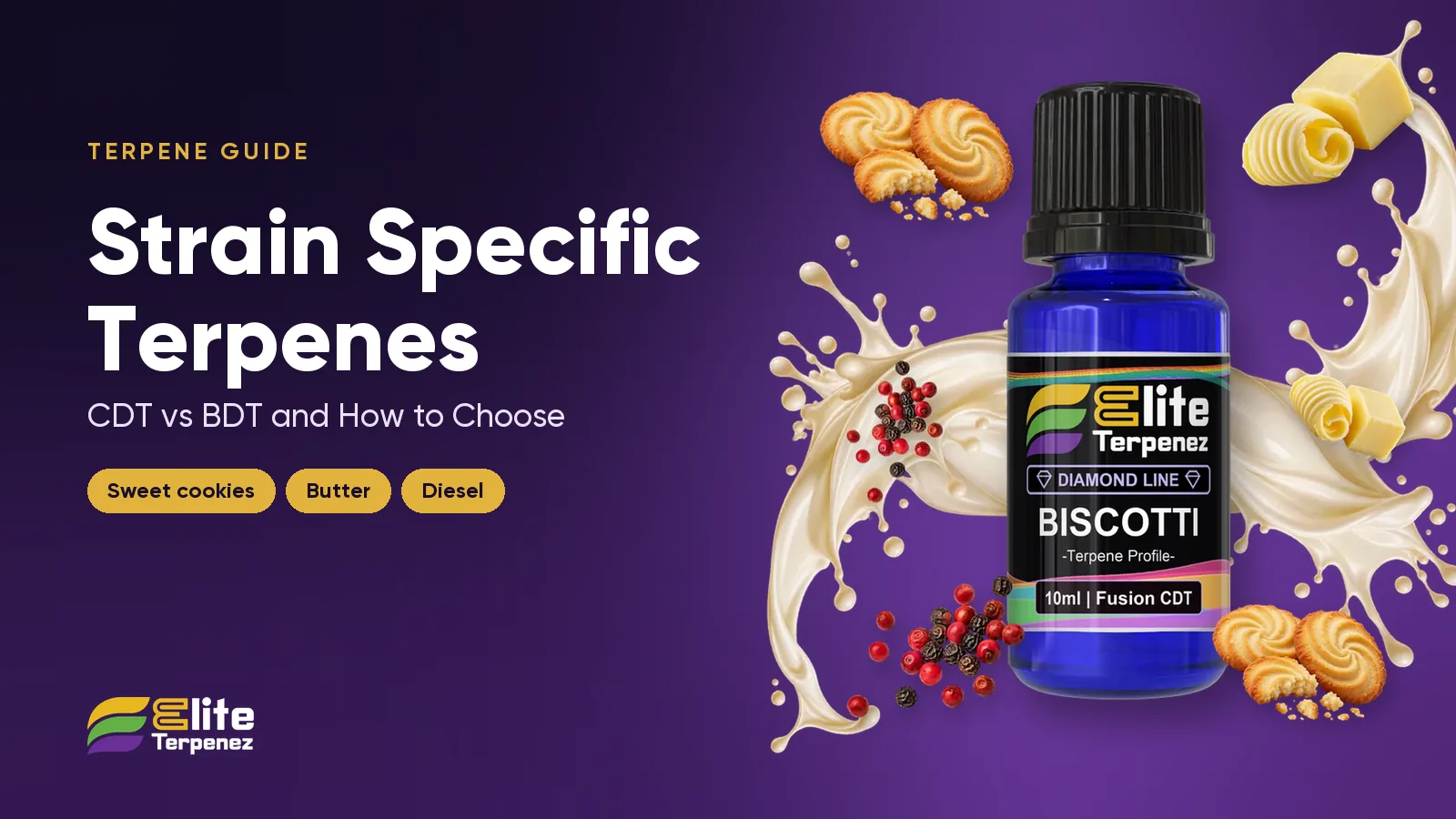
Key takeaways
- A strain-specific terpene profile is a recreation of one named aroma, built from many molecules. It is different from a single terpene such as limonene or myrcene.
- A strain’s smell is the sum of a few lead terpenes and dozens of minor aroma molecules, which is why the same name can smell different from one source to another.
- CDT profiles start from the cannabis plant’s own terpene mix. BDT profiles are blended from other plants and flavouring. Both are real terpenes, and neither is better in every case.
- Elite Terpenez sells 471 profiles: Diamond Line 17, Premium Line 64, Natural Terpenes 61, Infused Terpenes 87 and the Flavour Catalogue 242.
- Choose by target aroma first, then by line, then confirm with a 2 ml test batch in your own base.
- Cannabis flower is a controlled drug in the UK and Elite Terpenez does not sell cannabis. Strain names describe a flavour, not a product that contains the plant.
How does a strain-specific terpene profile differ from a single terpene?
Strain-specific terpenes are terpene profiles made to smell and taste like a particular named strain. The word “profile” matters. A profile is not one molecule but a whole aroma, built from a handful of lead terpenes plus many smaller aroma compounds that give the strain its character. A maker who asks for a Gelato or a Sour Diesel profile wants that recognisable smell, not a bottle of one chemical.
The idea sits between two extremes. At one end are single, isolated terpenes, such as the citrus note of limonene or the pine note of pinene. At the other is a full plant extract that carries everything the plant made. Strain-specific profiles aim for the second, because the smell people recognise as “Biscotti” or “Blue Dream” is the combination, not any one part. Our What Are Terpenes? guide explains the basics, and this guide goes deeper on the strain-specific side.
The search term has a few close relatives, and they all point at the same thing. “Terpene profiles” usually means the same blend-led products. “Cannabis-derived terpenes” and “cannabis terpenes” describe the source. “Strain-specific” describes the target. Each is answered below.
How is a terpene profile different from a single terpene?
A single terpene is one molecule with one smell. A terpene profile is a designed or extracted mixture with a layered smell. A strain-specific profile is a profile aimed at a named strain. The three behave differently when you use them, and mixing up the terms leads to buying the wrong thing.
| Question | Single terpene | Terpene profile | Strain-specific profile |
|---|---|---|---|
| What is it? | One molecule, such as limonene | A mixture of many aroma molecules | A mixture aimed at one named strain |
| Smell | One clear note, such as citrus peel | Layered, with top, middle and base notes | A recognisable strain aroma, such as toasted cookie and fuel |
| Predictability | High: the molecule is fixed | Depends on how it was made | Depends on the source and the match |
| Typical use | Building or adjusting a blend | Giving a whole product a smell | Matching a flavour customers already ask for |
| How Elite describes it | In our terpene guides | By its listed aroma notes | By strain name, line and listed aroma notes |
Elite Terpenez describes every profile by its listed aroma notes, never by percentages or recipes. A guide such as our myrcene guide or caryophyllene guide tells you what a molecule is. A product page tells you what a profile is meant to smell like.
How is a strain’s aroma rebuilt from named terpenes?
A strain’s aroma is rebuilt in layers. Plants make terpenes from the same five-carbon building blocks: monoterpenes such as limonene and myrcene have 10 carbons, and sesquiterpenes such as caryophyllene and humulene have 15, as the review Biochemistry of Terpenes and Recent Advances in Plant Protection sets out. Different plants combine those families in different ratios, and the ratio is what makes a smell.
A maker or formulator takes a target aroma and works through it in three layers:
- Top notes. The bright, volatile part you smell first, usually light monoterpenes. Citrus peel, fresh pine and mint-like notes live here.
- Middle notes. The body of the smell, from monoterpene alcohols and mid-weight molecules. Floral, herbal and fruity notes live here.
- Base notes. The slow, heavy part that lingers, mostly sesquiterpenes. Pepper, wood, spice and earth live here.
Then the formulator checks the balance against the target, adjusts and checks again. This is the same process for any aroma, from a lemon sherbet to a woody perfume. What is special about strain-specific work is that the target is a cultivar smell people know well, so a small error in the balance is easy to hear.
Which terpenes carry which aroma?
Each lead terpene brings a recognisable note. The table lists the ones named most often in strain descriptions, with approximate boiling points that show where they sit between top and base. Links go to our guides for each, and the figures come from PubChem records such as those for limonene and caryophyllene.
| Aroma note | Terpene most associated with it | Approximate boiling point | Layer |
|---|---|---|---|
| Citrus peel, lemon, orange | Limonene | About 175 to 178 C | Top |
| Fresh pine, resin | Pinene | About 156 to 165 C | Top |
| Herbal, ripe mango, musk | Myrcene | About 166 to 167 C | Top to middle |
| Fresh, piney, floral, herbal | Terpinolene | About 183 to 187 C | Middle |
| Floral, lavender-like | Linalool | About 198 to 200 C | Middle |
| Lilac, soft pine | Terpineol | About 217 to 221 C | Middle |
| Pepper, clove-like spice | Caryophyllene | About 256 to 259 C | Base |
| Woody, hoppy, herbal | Humulene | About 99 to 100 C at 3 mmHg | Base |
| Soft floral, honeyed | Bisabolol | About 314 C | Base |
Terpenes alone do not make every flavour. A “blueberry” or “vanilla cream” note is partly made by other aroma molecules such as esters, lactones and aldehydes, which is why profiles built for dessert and candy strains often list flavouring in their ingredients. Terpenes give the structure, and the other molecules supply the fruit and sweetness. Our terpenoids guide explains why the line between the two is blurry, since many aroma molecules are terpenes with an oxygen atom added.

A worked example: rebuilding Blue Dream and Biscotti
Take two strains with live write-ups on this site. Blue Dream is known for blueberry, vanilla and pine, and Biscotti for toasted cookie, butter and fuel. Lab reports on the flower commonly list myrcene, pinene and caryophyllene for Blue Dream, and caryophyllene, limonene and myrcene for Biscotti, though results vary by sample. These are general reports, not Elite recipes.
| Target | What the nose reads | Commonly reported lead terpenes in lab tests of the flower | Notes that terpenes alone do not supply |
|---|---|---|---|
| Blue Dream | Blueberry, vanilla, fresh pine | Myrcene, pinene, caryophyllene | The blueberry and vanilla sweetness |
| Biscotti | Toasted cookie, butter, fuel, spice | Caryophyllene, limonene, myrcene | The toasted, buttery, baked character |
To rebuild either, a formulator uses the lead terpenes for structure, then adds the smaller components that make the strain recognisable. Which route they take, and how closely the result matches, is the real difference between profile lines.
Why does the same strain name smell different from one source to another?
A strain name is a trade label, not a fixed chemical specification. Two samples sold under one name can come from different plants, different conditions and different processing, and each of those changes the terpene mix. Peer-reviewed genetic work backs this up: a study published in PLoS ONE, The Genetic Structure of Marijuana and Hemp, found that strain names often do not reflect a meaningful genetic identity.
| Source of variation | What changes | What it means for a profile |
|---|---|---|
| Genetics | Different plants sold under one name | The “target” is a range of smells, not a point |
| Conditions | The conditions a plant experienced shift the mix | Two lots from one plant can differ |
| Processing | Handling, extraction and refinement | The aroma you smell is not the aroma the plant made |
| Storage | Light top notes evaporate and others oxidise | An old sample smells flatter than a fresh one |
| Description | People describe smell in their own words | “Gas” and “funk” mean different things to different noses |
For a maker, the practical lesson is that a strain-specific profile is a consistent interpretation of a strain, not a copy of any one jar. Judge it by whether it gives your customers the smell they expect, and keep your recipe fixed once you find a profile that does. That also explains why we describe profiles by listed aroma notes and not by names alone.
What is the difference between cannabis-derived (CDT) and botanical-derived (BDT) terpenes?
Cannabis-derived terpenes (CDTs) are extracted from the cannabis plant and refined, so they begin with the strain’s own terpene mix. Botanical-derived terpenes (BDTs) are blended from terpenes found in other plants, plus flavouring where listed, to match a target aroma. Both are real terpenes, and the honest answer to “which is better” depends on what you are making and what you must document.
| Question | Cannabis-derived (CDT) | Botanical-derived (BDT) |
|---|---|---|
| Where do they come from? | The cannabis plant | Other plants such as citrus, pine, herbs and flowers, plus flavouring where listed |
| How is the aroma matched? | By extracting the strain’s own mix and refining it | By blending ingredients to match a target aroma |
| Closeness to the original | Closest in nuance, since it starts from the plant | A deliberate, faithful recreation of the smell |
| Consistency | Depends on the source material and refinement | Controlled by the blend recipe, so often steadier |
| Strain naming | Named for the strain it was taken from | Named for the strain it is built to resemble |
| Flavouring | Not listed for CDT-only lines | Listed in the ingredients where used |
| Questions to ask | Source, refinement and documentation | Ingredients, flavouring and documentation |
| Rules for your product | Ask about source and documentation for your market | Check the ingredient list against your own rules |
| Elite lines | Diamond Line and Premium Line; DNA Series uses both | Natural, Infused and most of the Flavour Catalogue |
Neither type is better in every case. A CDT is a good choice when you want the closest match to a strain’s own nuance. A BDT is a good choice when you want repeatable results from a blend recipe or have rules that favour non-cannabis sources. If you are unsure, test one of each in the same base and let your own nose decide. The source can matter for compliance in your own product, so ask before you build a recipe around a profile.
What about cannabis terpenes in the UK?
People searching for “cannabis terpenes UK” are usually asking two things: where to buy strain-style terpene profiles, and whether it is lawful. On the first, Elite Terpenez is a UK store selling terpene profiles to adults and businesses (18+) as flavour and aroma ingredients. On the second, the answer depends on what a product contains and how it is used, so we do not make a flat statement for every case.
Three points stay clear. Cannabis flower is a controlled drug in the UK, and Elite Terpenez does not sell cannabis. Our strain names describe a flavour, not a product that contains the plant. The main law is the Misuse of Drugs Act 1971, which you can read on legislation.gov.uk. Diamond Line terpenes contain no THC or other cannabinoids. For cannabinoid content of any other line, contact us and we will confirm before you order.
This is general information, not legal advice. Your own product is your responsibility, so check the rules that apply to it and take advice if you are unsure. Elite Terpenez sells terpenes as flavour and aroma ingredients and makes no claims about effects. Nothing here is medical advice. Our quality and safety page covers labelling, and our guide to choosing a UK terpene supplier lists the questions to ask any supplier.
What strain-specific terpenes does Elite Terpenez sell?
Elite Terpenez sells 471 terpene profiles in five lines, each in 2 ml, 5 ml and 10 ml bottles. The lines differ in where the aroma comes from and how it is described. We never state a profile’s contents or percentages, only its line, its listed aroma notes and its listed ingredients.
| Line | Type | Profiles | How it is described |
|---|---|---|---|
| Diamond Line | CDT | 17 | Cultivated cannabis-derived terpenes from a hydrocarbon-based extraction with tailored refinement to keep each strain’s nuance. Diamond Line terpenes contain no THC or other cannabinoids. |
| Premium Line | CDT | 64 | Live resin style, strain-specific cannabis-derived terpenes, each listed with its primary flavour, flavour notes and dominant terpenes. |
| Natural Terpenes | BDT | 61 | Natural botanical-derived profiles that capture the aroma and flavour of classic and modern strains. |
| Infused Terpenes | BDT with flavouring | 87 | Bold strain and dessert flavours. |
| Flavour Catalogue | BDT, plus CDT in the DNA Series | 242 | Five series in one place: DNA, All Natural Infused, Classic Flavour Infused, Flavour Infused and Classic Strains. |
The Flavour Catalogue is made up of five series you can also browse on their own: DNA Series (36 profiles, strain-true profiles built from the original cultivar, using CDT and BDT), All Natural Infused (30), Classic Flavour Infused (30), Flavour Infused (96) and Classic Strains (50). Two Classic Strains profiles list a water-soluble carrier, so read the ingredients field before you buy for a particular base.

What does one strain look like across the lines?
The clearest way to see the lines is to compare one strain across them. Blue Dream is sold in six of our lines, each with its own listed notes. The notes are close, and the differences are in emphasis, source and ingredients. The fact that a strain appears in several lines is useful: you can sample two or three and pick the one that suits your base.
| Profile | Line (type) | Listed aroma notes | Ingredients |
|---|---|---|---|
| Blue Dream | Premium Line (CDT) | Sweet, berry, herbal | Cultivated cannabis-derived terpenes |
| Blue Dream DNA | DNA Series (CDT and BDT) | Blueberry, summer berries, fresh pine | Cannabis-derived and botanical-derived terpenes |
| Blue Dream | Natural Terpenes (BDT) | Sweet blueberry, soft vanilla, gentle herbal finish | Botanical-derived terpenes |
| Blue Dream | Classic Strains (BDT) | Ripe blueberry, juicy berry, fresh pine | Botanical-derived terpenes |
| Blue Dream | Classic Flavour Infused (BDT) | Ripe blueberry, soft fruit, fresh pine | Botanical-derived terpenes and flavouring |
| Blue Dream | All Natural Infused (BDT) | Sweet blueberry, soft vanilla, mellow herbal base | Botanical-derived terpenes and natural flavouring |
Read the table as a map of choices, not a ranking. The Premium and DNA profiles lean on cannabis-derived terpenes. The Natural and Classic Strains profiles reach a similar target from botanical sources. The two infused versions add flavouring, which suits a sweeter, more dessert-like reading. The same pattern holds for Biscotti, which our Biscotti strain guide compares across the Diamond Line, Classic Flavour Infused and All Natural Infused versions.
Which line should you choose for which job?
Match the line to the job first, then pick a profile within it. The table is a starting point, not a rule, and many makers sample from two lines before settling.
| If you need | Start with | Example (listed aroma notes) |
|---|---|---|
| The closest match to a named strain, from cannabis-derived terpenes | Diamond Line or Premium Line | Biscotti Diamond Line: sweet cookies, butter, diesel, spice |
| A strain aroma without cannabis-derived terpenes | Natural Terpenes or Classic Strains | White Fire OG: crisp pine, sharp lemon, earthy peppery base |
| A bold dessert or candy flavour | Infused Terpenes or Flavour Infused | Wedding Cake Flavour Infused: vanilla sponge, buttercream frosting, soft creamy finish |
| A strain flavour with a flavouring lift | Classic Flavour Infused or All Natural Infused | Biscotti All Natural Infused: toasted cookie dough, sweet spice, nutty earthy edge |
| A profile built from the original cultivar | DNA Series | Blue Zushi DNA: sweet blueberry, cool mint, gassy tropical finish |
| A pure citrus or fruit lead, not tied to one strain | Any line | Orange Tree: orange peel, citrus blossom, woody edge |
For strain-style flavours, the live strain write-ups give more detail on listing matches: Wedding Cake, Zkittlez, Sour Diesel, Purple Punch, Ice Cream Cake and Lemon Cherry Gelato.
How do you read a strain-specific product page?
Every Elite Terpenez product page gives you a small set of fields, and each tells you something different. Knowing what they do and do not say stops you assuming too much.
| Field | What it tells you | What it does not tell you |
|---|---|---|
| Series or line | Where the profile sits in the range, and so whether it is CDT or BDT | Anything about how loud or soft the profile is |
| Strain type (indica, sativa, hybrid) | The trade label usually attached to the strain’s name | The smell, which comes from the aroma notes |
| Aroma notes | The smell the profile is built to give, in plain words | Percentages or a recipe |
| Ingredients | Whether it is cannabis-derived, botanical-derived or both, and whether flavouring is listed | The quantity of any ingredient |
| Sizes | 2 ml, 5 ml and 10 ml, with bulk on request | How much your batch needs, for which see the terpene mixing calculator |
Elite labels carry a QR code that opens that exact profile and size on the website, as described in our bottle labels and QR codes post, so the page you read before you buy is the page you can reach from the bottle.
Which aroma family does your target belong to?
Most strain-specific profiles sit in a handful of aroma families. Knowing the family helps you choose a profile and spot gaps in your range. The terpenes shown are those commonly reported in lab tests of the flower for the examples, and are general reports, not Elite’s recipes.
| Aroma family | What it smells like | Commonly reported terpenes in the flower | Example strain write-ups |
|---|---|---|---|
| Cookie and cake | Toasted biscuit, vanilla frosting, butter, spice | Caryophyllene, limonene, myrcene | Biscotti, Wedding Cake |
| Candy and tropical fruit | Sweet candy, berry, tropical fruit | Caryophyllene, humulene, limonene | Zkittlez |
| Berry and pine | Blueberry, vanilla, fresh pine | Myrcene, pinene, caryophyllene | Blue Dream, Blue Zushi |
| Fuel and lemon | Diesel, sour lemon, earth | Caryophyllene, myrcene, limonene | Sour Diesel |
| Grape and berry punch | Sweet grape, jammy berry, soft vanilla | Varies by sample | Purple Punch |
| Dessert and cream | Vanilla ice cream, sponge, buttery finish | Varies by sample | Ice Cream Cake |

How do you pick a strain-specific terpene profile?
Pick by working from the smell you want back to the product, in a few clear steps. The process saves money, because the cheapest mistake is a 2 ml test and the dearest is a bulk order of the wrong profile.
- Write down the target in plain words. “Sweet cream, cookie dough and a little fuel” is a better brief than a strain name alone.
- Pick the line. Decide between cannabis-derived and botanical-derived sources, based on your product, your documentation and your rules.
- Shortlist two or three profiles. Use the listed aroma notes, and include the same strain from two lines if it exists.
- Order the 2 ml size. A small bottle is enough for several test batches.
- Test in your own base. The same profile smells different in an oil, a glycol and a wax.
- Judge after a day and after a week. The smell settles as the batch rests.
- Lock the recipe. Write down profile, weight, percentage, base and date, then order the larger size.
The starting cuts we suggest, as a percentage of total batch weight, are 6% for vape cartridges, 4% for concentrates, 3% for topicals, 2% for tinctures, 1% for edibles and 0.5% for beverages. They are starting points only, intended for adults making products within the law. Use the terpene mixing calculator to turn a percentage into a weight and a bottle size, and always test a small batch first. Terpene profiles are concentrated and must never be used undiluted. Wear gloves and eye protection, and keep them away from children, pets, heat and flames. The calculator update is explained in our bottle-mix news post.
What mistakes do buyers make with strain-specific profiles?
Most disappointments come from a few repeatable misreadings, not from the profile itself.
- Assuming the name guarantees the smell. A strain name is a target, and a profile is one interpretation of it.
- Treating the strain type as an aroma guide. Indica, sativa and hybrid are trade labels. The aroma notes tell you the smell.
- Buying one line only. The same strain in two lines can read quite differently in your base.
- Expecting a single terpene to do a profile’s job. A flavour is a blend, so adding limonene to a profile will not turn it into lemon sherbet.
- Skipping the test batch. A bold profile can overwhelm a delicate base.
- Ignoring the ingredients field. It tells you whether a profile is CDT, BDT or both, and whether flavouring is listed.

How do strain-specific profiles keep their character in storage?
Store them like any concentrated terpene: tightly closed, cool and dark, and refrigerated if you can. The lightest molecules, the ones that give the top note of a profile, are the first to escape, and oxidation slowly changes the rest. Keep the bottle full, open it once, and write the opening date on it. If a profile begins to smell different from a fresh sample, test again with fresh material before changing the recipe. Our pillar page and FAQ cover storage in more detail.

Can you order strain-specific terpenes in bulk?
Yes. All profiles come in 2 ml, 5 ml and 10 ml, and larger quantities are available on request. UK brands and manufacturers can ask about bulk quantities and repeat orders. If you already work with another supplier’s profile, tell us what you use and we will suggest the closest Elite match. Start from our wholesale and bulk page and read the news post on wholesale accounts for UK brands. Free UK delivery on orders over £80.
Frequently asked questions
How does a strain-specific terpene profile differ from a single terpene?
Strain-specific terpenes are terpene profiles made to match the aroma and flavour of one named strain, such as Biscotti or Blue Dream. A profile is a blend of many aroma molecules, not a single terpene. It may come from the cannabis plant itself (CDT) or from other plants and flavouring (BDT).
What is the difference between terpene profiles and single terpenes?
A single terpene is one molecule with one clear note, such as limonene’s citrus peel. A terpene profile is a layered mixture that recreates a whole smell, with top, middle and base notes. Profiles are what makers use to match a recognisable flavour, while single terpenes are used to adjust or build one.
What are cannabis-derived terpenes?
Cannabis-derived terpenes (CDTs) are terpenes extracted from the cannabis plant and refined, so they start from a strain’s own terpene mix. At Elite Terpenez they are the Diamond Line and Premium Line, and part of the DNA Series. They are sold as flavour and aroma ingredients. Diamond Line terpenes contain no THC or other cannabinoids.
Are cannabis terpenes legal in the UK?
It depends on what a product contains, where its terpenes come from and how it is used, so there is no single answer. Cannabis flower is a controlled drug in the UK, and Elite Terpenez does not sell cannabis. For any line other than the Diamond Line, contact us and we will confirm cannabinoid content before you order.
Should I choose cannabis-derived or botanical-derived terpenes?
Choose cannabis-derived terpenes for the closest match to a strain’s own nuance, and botanical-derived terpenes for a repeatable blend recipe or where your rules favour non-cannabis sources. Neither is better in every case. Test one of each in your own base with 2 ml bottles, and ask us about documentation before you build a recipe.
How many strain-specific profiles does Elite Terpenez sell?
Elite Terpenez sells 471 terpene profiles: Diamond Line 17, Premium Line 64, Natural Terpenes 61, Infused Terpenes 87, and the Flavour Catalogue 242, which holds the DNA, All Natural Infused, Classic Flavour Infused, Flavour Infused and Classic Strains series. Each comes in 2 ml, 5 ml and 10 ml bottles.
Which Elite Terpenez profiles are suggested for strain specific terpenes, and what are their listed notes?
Start with Diamond Line Biscotti (sweet cookies, butter, diesel, spice); Premium Line Blue Dream (sweet, berry, herbal); Natural Terpenes Blue Dream (sweet blueberry, soft vanilla, gentle herbal finish). Notes come from each product page, and every profile is sold in 2 ml, 5 ml and 10 ml bottles.
Ready to match a flavour? Browse the Diamond Line, Premium Line and Flavour Catalogue, order a 2 ml bottle to test, or contact us for bulk quantities and to confirm anything about a profile before you order.